

Return of Wild Buffalo to Banff National Park - Part 2
September 14, 2024
By January 2019, the buffalo at Banff had been free-roaming for 5 months, after being released from their small enclosed pasture in the remote Panther Valley. They are being tracked and monitored by the Banff bison scientists with the help of GPS collar data, remote cameras and field observations.
by Francie M. Berg
By January 2019, the buffalo at Banff had been free-roaming for 5 months, after being released from their small enclosed pasture in the remote Panther Valley. They are being tracked and monitored by the Banff bison scientists with the help of GPS collar data, remote cameras and field observations.

The buffalo choose to spend summer months at high elevations and the shores of alpine lakes. With the cooler days of fall they came down to lower levels where grazing was good. Courtesy of ©Parks Canada / Banff National Park
After their release, they spent their summer months at high elevations—along talus slopes and shores of alpine lakes. Then with the cooler days of fall, they came down to lower elevation meadows for excellent grazing on the grassy slopes and areas that were control-burned in the Panther and Red Deer valleys.
It takes two days for park rangers to get to these remote pastures on foot, ski or horseback, for observations on site.
“It is incredible to see these animals thriving in the wild after an absence of 140 years,” the Banff team reported. “With each passing day, they continue to prove that bison really do belong in Banff National Park.”

Since July 2018 the Banff herd has been free-roaming. The Red Deer and Cascade Expansions were opened (blue areas), with drift fencing (red), close monitoring and hazing if needed to encourage the buffalo to stay within the desired areas (green and blue). Image courtesy of ©Parks Canada / Banff National Park.
The 10 cows calved twice in the Soft-Release Pasture in Panther Valley—in the spring of 2017 and 2018—to help them feel at home in the mountains. This increased the herd by over 50%, bringing the total to 36, adding 20 calves to the original 16 adults brought from the plains of Elk Island National Park.
High-Tech Meets Wilderness—Parks Canada Learns from the Herd
The Banff Bison Team is highly committed to educating the public about the many aspects of the reintroducing the buffalo to remote areas of the Canadian Rocky Mountains where they lived 140 years ago.
1.They emphasize the ecological and conservation benefits that bison can bring to change the landscape and enrich plants and animals.
2.They are committed to helping indigenous people of the area renew their cultural and historical connections with the animals their ancestors once hunted here.
3.They are committed to increasing opportunities for Canadians and visitors to learn about the ecological and cultural importance of this iconic animal that once held such importance for Native people and early settlers in the area.

The staff is invested in helping Native people renew their cultural and historic connections with the buffalo that their ancestors once hunted here. Courtesy of ©Parks Canada / Banff National Park.
Canadians, and indeed, people throughout the world both adults and children are urged to follow the Banff buffalo herd online and to participate in related activities.
“Follow the herd from home! See what life is like for the calves by watching our new webisode on YouTube. Share it with your friends and family on social media,” they challenge.
We can all connect by following their Bison Blog, Twitter and Facebook accounts, a YouTube web series, and attending fun interpretive programs in the Banff townsite and day-use areas. Live or online.
Following are reports from 2019 and 2020 Blogs:
“The return of bison to Banff National Park is an exciting experiment in a giant natural laboratory. To observe the herd as they reintegrate into the ecosystem, our scientists use remote technology that allows us to collect information without disturbing the animals.
“Here are some of the tools we use to monitor the herd and what the research reveals.”

The team monitors buffalo herd with long-distance scopes and other high-tech equipment. Photo courtesy of ©Parks Canada / Banff National Park.
1–Herd tracking
“We rely on GPS radio collars as our most essential tool to monitor herd movements. Before we released the herd into the wild, we collared all the adults. The collars beam location information via satellites to a web platform that our team can access from the office.

Staff riding into the remote area of Panther Valley with pack horses. It takes two days to get there via horseback—or skiing or on foot—from any direction. Courtesy of ©Parks Canada / Banff National Park.
Panther Valley is located in one of the most remote parts of the park. It takes two days to get there on foot, ski or horseback from any direction.
“The collar data tells us about how the animals adapt to their new home and the type of habitat they prefer. We closely observe which animals travel together, and for the most part, they have all been travelling as a large group with some side adventures along the way.
“The collars give us insight into how bison interact with other species. For a few months, we watched with curiosity as collared wolves came to investigate and the bison stood their ground.
“Unfortunately, we only observed a few interactions before the wolves ventured outside of the park boundaries where they were legally trapped and killed. We also recently collared 10 bighorn sheep within ‘bison country’ to gather information about how bison affect sheep movements and habitat use.
“Collars allow us to pinpoint the location of the herd when we are in the field. Our scientists use a radio telemetry receiver to pick up the unique signal of each collar. Then, they can approach the herd from a safe distance to record data on behaviour, herd health and number of animals.
“Unfortunately, the collars have a limited lifespan, and many of the original collars have naturally dropped off—leaving 6 operational collars. We plan to recollar at least 3 animals this winter to maintain the vital flow of data about the herd.”
2 – Remote cameras
“Banff’s bison travel through rugged country that is difficult to access, and they are sensitive to human presence. That is where another important piece of technology comes in: remote cameras.
“Our network of remote cameras captures the secret life of the herd. We set them up along trails we know the animals use. When an animal passes by, it triggers a sensor and captures a photo or video.
“Images from remote cameras reveal information that would be difficult to observe in person, such as detailed health observations. Remote cameras also capture some special moments that would otherwise go unseen, like this photo of three generations of the herd all in one frame.
“Our network of remote cameras captures the secret life of the herd. We set them up along trails we know the animals use. When an animal passes by, it triggers a sensor and captures a photo or video.
“Images from remote cameras reveal information that would be difficult to observe in person, such as detailed health observations. Remote cameras also capture some special moments that would otherwise go unseen, like a photo of three generations of the herd all in one frame.”
3- Scat sampling
“Wherever bison roam they leave behind bison dung, a stinky but important clue that tells us what they are eating.
“As part of a long-term monitoring program, our scientists collect dung samples from the field. We analyze the samples in the lab to track the types of plants the bison have been eating. The data helps us learn about the Banff bison diet and the type of habitat they need to thrive.”
4 – Bird monitoring
“If you see a bird soaring above you in some of Banff’s most remote valleys, a bison may have helped raise it! Birds and bison have a special relationship. Some birds, like the Brown Headed Cowbird, co-evolved with bison to pluck bugs from their back.
“Others, like the Olive-sided Flycatcher, use fuzzy bison wool to line their nests. Bison also increase grassland habitat that benefits meadow-loving birds.
“To assess the effects of bison on birds, we monitor bird populations both inside and nearby the bison reintroduction zone. By recording birdsong in the same places each spring, we track changes in species diversity and distribution.
“This non-invasive method gives us a greater understanding of the cascading impacts of returning a keystone species to the ecosystem.
“Our research in the backcountry of Banff National Park is on the leading edge of conservation science. As one of only 8 wild herds in North America, what we learn from the Banff bison herd benefits the broader world of bison conservation.”
February 2019: One Lonesome Buffalo
“When the bison herd crossed the threshold between captivity and freedom in the wilderness of Banff National Park, it was a historic moment for conservation.
“It was also the start of what has since become a solitary life for one of the herd’s bulls—bull #18— in one of Banff’s remote valleys. This blog traces his journey since the herd was released.
“The herd is spending its first morning in the wild, high on a talus slope. #18 initially grazes alongside the herd but soon breaks from the group and continues northwards, leaving the rest of the herd to meander the ridges of the Snow Creek Valley in search of alpine plants.

Number 18, a lonesome bull wanders alone for months. He weaves his way between willow bushes, naps at high alpine lakes and trudges through thick forest. Will he continue his solo journey thru Banff’s remote valleys? Photo courtesy of ©Parks Canada / Banff National Park.
“Edging across the slopes, #18 weaves his way between willow bushes and ambles down an old trail into the Red Deer Valley. For days, he explores meadows in the valley bottom. He picks through pockets of vegetation in an old burned forest.
“He eventually travels east, like the herd’s 2 other lone wandering bulls, but unlike them, he bumps into a stretch of fencing at the park boundary and returns westward. It would be the only interaction with a fence he has for the next 6 months.
“On his westerly trek back into the heart of the reintroduction zone, he turns north to follow Divide Creek. Along the way, he naps at an alpine lake and trudges through thick forest. He finally arrives in the Clearwater Valley in early September.
“This area is within the park but outside the reintroduction zone, so we deploy our staff to apply gentle pressure to redirect his movements. These efforts work to get the momentum started, and within a couple of days, he returns to his frequent haunt—the old burn in the Red Deer Valley.
“In late September, #18 makes a surprise reunion back with the main herd that is grazing in the Panther Valley. For a few days, they travel in lockstep, and then they part ways once more. #18 plods his way back to the Red Deer Valley, alone.
“For months now, #18 has spent the majority of his time in the Red Deer Valley. According to our GPS data, he has crossed paths more often with the resident wolf pack than with other bison.
“It’s normal for bulls to separate from the herd during the winter months. Bulls of breeding age tend to rejoin the herd for mating season in late July and August. What is interesting about #18 is his contrast with other bulls.
“Upon arrival to Banff, he was the oldest bull, but according to our field observations, he was one of the least dominant bulls during the soft-release phase. Following the full-release, the 2 most dominant bulls left the project area and were removed from the project, while the other bulls have generally stayed with the main herd.
“Each passing season teaches us more about Banff’s bison. Data from #18 and the rest of the animals, gathered through GPS collars, remote cameras and field observations, will help us understand how they establish home ranges and what influences their movements.

Buffalo are sensitive to human presence. The network of remote cameras captures the secret life of the herd. Remote cameras capture some special moments that would otherwise go unseen. Photo courtesy of ©Parks Canada / Banff National Park.
“We are looking forward to the spring/summer to learn more about #18’s behaviour. Will he return to the herd for mating season or will he continue his solo journey thru Banff’s remote valleys? Stay turned for updates on their movements in the coming months.
[Later:] “On a recent trip into the backcountry, our staff observed the main herd grazing in the Red Deer Valley. Everything looked normal…until we noticed the adult bull was different.
“It was no longer Bull #4 (who had been with the main herd for over a year) but Bull #18—the lonesome buffalo we wrote about back in February 2018! After a year of self-exile, Bull #18 is making some new friends.”
November 2, 2019 – Walking with Bison
“Indigenous peoples have a historical and cultural relationship with bison that spans thousands of years. The reintroduction of bison to Banff National Park fosters reconnection of this important relationship, inspires discovery, and provides stewardship and learning opportunities.
“In summer 2019, Parks Canada led a group of youth filmmakers from Treaty 7 though the remote Red Deer Valley where bison roam once again. In partnership with the Banff Centre, these filmmakers from the Nakoda A/V Club and the Napi Collective created short films inspired by their experience.
“This guest blog, written by Amber Twoyoungmen of the Nakoda A/V Club talks about the ‘making of’ and the significance of the return of bison to Treaty 7 Territory:”
“The Nakoda A/V Club is a group of young emerging Indigenous artists from the Bow Valley making films and animations about narratives that matter to us. We work together to help each other to get through tough times and to create opportunities for each other to express our stories.

The Parks Canada team led a group of youth filmmakers—emerging Indigenous artists from the Bow Valley—through the remote Red Deer Valley where bison roam once again. “We made a movie to help tell the story.” Photo courtesy of ©Parks Canada / Banff National Park.
“In the fall of 2018 we learned about the Bison being reintroduced in Banff National Park. We saw the films that Parks Canada made about the project, and we thought about what we could add to the story.
“Bison matter to Nakoda because they were always part of this place. They belong here. Their presence is part of the Bow Valley, just as the presence of people is. At one time, Banff was understood by my people as a place of gathering, of trade, and of healing.
“We asked Parks Canada if we could help tell the story of the return of bison, and we were so happy they agreed! We invited out our neighbors, the Napi Collective from the Siksika Nation to tell stories too, because they belong here also.
“We gathered at Banff Centre to think about the stories we wanted to tell, and to learn about Bison. Some of our members got to go to the Red Deer Valley where the Bison live! When they came back, they told us about what is was like, and they’ll tell you too.”
Javan Twoyoungmen: “Being invited out to the backcountry of the Rocky Mountains was an incredible experience….The Rockies hold a precious history with the Nakoda people, walking the path my ancestors once took was a memorable experience one that I will never forget.”

Javan Two Youngman walked the path his ancestors took in the Banff backcountry. An experience “I will never forget.” Photo courtesy of ©Parks Canada / Banff National Park.
Iris Clarke: “I can honestly say it was the hardest thing I’ve ever done in my life. I didn’t think I could hike that far. But it was the most rewarding too.”
Tashina Ear: “My experience hiking with the Parks Canada crew was very exciting but most of all, a great opportunity to learn with Parks Canada. Those very paths were also the same trails our Nakoda ancestors had walked through and I’ve never realized how hard they worked, and how long their days must have been. Our ancestors were so strong, and I want to be like them. I’ve been on simple little two-hour hikes but nothing compared to this! I’m greatly appreciative that I was given this opportunity to hike with Nakoda A/V Club members and the staff from Parks Canada.”
“After the hike, we made a movie. We used everything we learned, and everything we thought about to help tell the story we wanted to tell. As part of making that movie, we camped together, we hiked, we swam, and we went back to Banff to edit our work with the support of Banff Centre. Then we will be able to present what we made and what we learned as part of the Banff Mountain Film Festival.
“The project was such a great opportunity. Bison matter not just to us but also to lots of beings in the mountains. Parks Canada taught us about how Bison leave fur for nests, make indents for pools of water to grow, and help to create conditions for grasses to thrive.
“At one time, I might have learned this by watching the Bison here in the Bow Valley, and I’m sad that’s not the case anymore, but I’m so excited that some of our members did get to learn this way by hiking in the Red Deer Valley!
“That’s a connection to who we used to be, and who we might be again someday. In the future, our story will include all the new people in the Valley too, just as this part of our story is so intertwined with Parks Canada.
“It’s an honor to work on something important. We loved working with Parks Canada to tell the story of the return of bison to Banff. Like all our stories, it’s not meant to have an end, it’s meant to be re-told, and shared often, because in the sharing of stories we bring our gifts to the valley, just like the Bison leaves its fur for all the small birds.”
“Thank you to guest blog writer, Amber Twoyoungmen and to all of the participating filmmakers for sharing their stories with us.”
February 14, 2020: Banff’s First Wild Bison Death in 140+ Years
“We knew it was going to happen eventually: one of Banff’s bison has gone missing and, given its young age, we expect it died of natural causes.
“Back in late September, one of our staff noticed one of two bison calves born in the wild this past June was no longer with its mother and the rest of the main herd. Meanwhile, a smaller, much fuzzier and reddish calf was sticking close to another cow. Back in the office, a report was filed: one calf lost, another calf just born.

What became of the missing calf? Though sad, this first bison death is an indication of success. From this perspective, the calf still lives.” Photo courtesy of ©Parks Canada / Banff National Park.
“More than a month passed before staff could train binoculars on the increasingly elusive herd and corroborate the observation. A few weeks later, images from one of our remote cameras confirmed the situation.
“What became of the missing calf? As scientists and conservation staff overseeing the reintroduction project, we’d love to know exactly what happened, but the vastness of the 1200 km2 reintroduction zone, coupled with the increasing wildness of the herd (the missing calf’s mother is not radio collared) means we probably never will.
“This is simply an example of nature taking its course within a healthy ecosystem. The calf may have died from a predation event, succumbed to an injury or simply died in this harsh mountain environment through exposure to many natural hazards including severe weather, steep terrain and challenging stream crossings.
“What we do know is that nature wastes nothing and this first natural bison death in over 140 years will be a gain for the ecosystem of Banff National Park.
“Dozens of scavengers, including pine martens, ravens, voles, coyotes, beetles—and maybe even a wolverine or bear—will have already converted a new but ancient kind of meat, sinew and bone into their own muscles and perhaps even growing fetuses.
“And next spring the grass will be a little lusher where the bison died and the birds will be a little more active, swooping down for the insects that will still be cleaning up the site, and salvaging the remaining tufts of bison hair which the birds will use to line their nests.
“Although sad, this first bison death is an indication of success for the reintroduction project; Parks Canada’s goal, from the beginning, has been to restore the missing roles and relationships of bison within the ecosystem, not just bring back a missing animal.
“Looking at it from this perspective, the calf still lives.”

Buffalo follow single file along the edge of the lake, high in the mountains above the tree line. Photo courtesy of ©Parks Canada / Banff National Park.

Airlifting supplies deep into the remote country of Banff National Park. Staff prepares for drop from the helicopter high overhead, May 20, 2020. Photo courtesy of ©Parks Canada / Banff National Park.
Links to Parks Canada information on the 5-year project that is returning Wild Buffalo to Banff National Park are as follows:
https://www.pc.gc.ca/en/pn-np/ab/banff/info/gestion-management/bison
https://www.pc.gc.ca/en/pn-np/ab/banff/info/gestion-management/bison/faq
https://www.pc.gc.ca/en/pn-np/ab/banff/info/gestion-management/bison/blog
Follow the landmark journey of returning North America’s largest land mammal to Canada’s first national park with the links below:
http://www.parkscanada.gc.ca/banff-bison
First published June 16, 2020

Returning Wild Buffalo to Banff National Park — Part 1
August 10, 2024
For over a century, Parks Canada has been leading the charge to restore wild bison in Canada.
One of its first ventures was the display buffalo herd placed in a small 300-acre paddock near Banff in 1885.
Canada’s oldest national park—Banff National Park—is near the mountain resort of Banff and Lake Louise.
by Francie Berg
For over a century, Parks Canada has been leading the charge to restore wild bison in Canada.
One of its first ventures was the display buffalo herd placed in a small 300-acre paddock near Banff in 1885.
Canada’s oldest national park—Banff National Park—is near the mountain resort of Banff and Lake Louise.

Moraine Lake in Banff National Park. Above the tree line—at about 2,300 m (7,500 ft)—the rugged mountains here are primarily rocks and ice. Rivers cut through deep canyons. Photo courtesy of Brandon Jean
The scenery is spectacular, with rugged mountains rising on every side. The tree line is at about 2,134 m (7,000 ft), and above this is mostly rocks and ice.
Unlike other western mountain towns that focused on mining or agriculture, Banff was built as a tourist destination from the beginning. Planners for the Canadian Pacific Railroad built across Canada in 1885, discovered hot springs there and pronounced it tourist-worthy. The original Chalet Lake Louise was built on the lake shore in 1890.
At the time there were no roads. Only the transcontinental railway, towering Canadian Rockies, glaciers and rushing mountain rivers.
Now three to four million visitors come to the Banff area every year.
Thirteen of the early buffalo there were donated from the Bedson herd by Sir Donald A. Smith, Lord Strathcona, purchased from Samuel Bedson, warden of the prison near Winnipeg.
They originated with James McKay of Winnipeg, who rescued calves during Metis hunts in the western plains of Canada. Three more—two cows and a bull—were donated by Charles Goodnight from his Texas herd.

A display herd of buffalo at Banff was one of its early tourist attractions, beginning in 1885. It persisted there for over 100 years, but is now being replaced by free-roaming buffalo in the back country of Banff National Park. ©Parks Canada / Banff.
Buffalo were kept for over 100 years in a small enclosure near the railroad. Until 1997 the buffalo herd was a popular tourist attraction.
But it had served its purpose. It was time to move on.
The dream was always for free-roaming buffalo in the backcountry of Banff National Park, as in prehistoric days when they were hunted by indigenes people.
“Homecoming to Banff” planned
Twenty years went by before the 5-year restoration plan was ready.
The historic “Homecoming to Banff” was planned as a high-tech, scientific experiment producing a wealth of detailed research data.
One of the first questions Parks Canada personnel asked was: How do you get Plains buffalo to bond to a Rocky Mountain home?
Seasoned buffalo handlers were in agreement: Buffalo cows from the plains need to calve in the mountains before they will accept it as home. Otherwise, any self-respecting buffalo herd will travel until they reach a place they like—breaking down fences and trampling crops as needed to get there.
Cattle ranchers voiced concerns that buffalo would escape, damage property and spread disease to livestock. In response, the planners included a hazing zone, recapturing, and as a last resort destroying the animals. If they detect disease they agreed to cull the herd.
Goals of reintroduction
The reintroduction of bison to Banff brings back a keystone species that will:
• Support ecological integrity;
• Contribute to bison conservation since plains bison are only protected in three herds in less than 0.5% of their original range in Canada;
• Reconnect indigenous peoples and bison; and
• Create new opportunities for visitors and Canadians to learn about the ecological and cultural importance of bison.

Reintroduction of bison included a Blessing Ceremony with staff and Indigenous people in Banff National Park. Photo courtesy of ©Parks Canada / Banff National Park
The Parks Canada five-year plan includes:
Year 1 and 2 (2017-2018) involved a soft-release in Banff National Park.
The soft-release plan includes bringing young pregnant cows with a few bulls to a desirable, but remote, mountain valley in Banff National Park, Alberta, Canada, where they’d give birth to their first calves under the watchful eyes of biologists.
Carefully selected, the young herd came from the disease-free, extensively-tested and vaccinated herd at Elk Island National Park, which is just east of Edmonton, Alberta, in the Great Plains.
They were to be held for “summer vacation” in a small enclosed pasture in remote Panther Valley and fed hay that first winter. The following spring they calved a second year in the small “soft release” pasture of their new home. Gradually fences and barriers were moved giving access to an increasingly larger area.
Years 3 to 5 (2018-2022) the herd will at last be free to range—free-roaming it’s called.
They will range through the east part of the park where they will continue to live year around from then on in a wild state. The barriers are let down between the initial area to the Red Deer and Cascade Rivers expansion. A larger “Hazing Zone”

The Panther and Dormer River Valleys in the eastern part of Banff National Park form the core of the initial reintroduction zone, spanning 1200 km2 (463 mi2; green). Within this is the small Soft Release Pasture System (green dot). During the 5 years the Red Deer and Cascade Expansions (blue) will be added. The Hazing Zone is yellow. Short stretches of wildlife-friendly drift fencing (red) encourage bison to stay within the reintroduction zone—and outside the hazing zone—while allowing other wildlife to pass safely in and out of the park. Map courtesy of ©Parks Canada / Banff National Park.
The rangers at Parks Canada brought it all together just in time to celebrate Canada’s 150th anniversary year.
On April 25th, 2017, they loaded 16 buffalo—12 two-year-old females and four two-year-old bulls—into shipping containers on trucks in Elk Island National Park and trucked them to Banff National Park.
There each shipping container—containing three or four husky buffalo—was picked up by helicopter and, dangling through mountain valleys by a metal cable, called a longline, was airlifted to their new soft release pasture in the Panther River valley.
There in grassy river bottom lands the shipping containers were dropped gently down at the edge of the forest.
Parks Canada personnel opened the containers and the buffalo burst out on the run.
Sixteen buffalo were loaded in shipping containers at Elk Island National Park and trucked to the Banff park. A helicopter then airlifted the containers to the soft-release pasture in a remote part of the park where they were opened and the bison released. Video courtesy of ©Parks Canada / Banff National Park.
It was a remarkable moment as the buffalo charged into the verdant green mountain valley, looked around and began eating.
Ten healthy bison calves were born in the soft release area of Banff National Park’s remote backcountry before the end of May.
The new calves brought the herd number to 26. They mingled with the herd, napping in the sun, running and playing together.
In July, the soon-to-be-wild herd was moved from their 6-hectare winter pasture into a 12-hectare (30 acre) summer pasture, which includes tasty mountain grass, instead of the dry hay they are used to.
They drank from a clear, flowing river, instead of a cattle trough, and for the first time ever faced mountains to climb and explore.
This was a big change for these young animals. There is no running water or steep hills to climb in the safe plains pasture where they grew up in Elk Island National Park.
These new arrivals represent the future of buffalo restoration in Banff. They are part of the larger vision to reintroduce wild bison, and their gradual introduction to the park will help this herd anchor to the landscape and adopt it as their new home.
The Parks Canada team is committed to involving the public in the buffalo reintroduction effort. A well-considered, illustrated blog provides students and adults with fascinating details.
People throughout the world are being urged:
“Follow the herd from home! See what life is like for the calves by watching our new webisode on YouTube. Share it with your friends and family on social media.”
Herd dynamics—Cliques, leaders and rebels
“The herd arrived in Panther Valley in early February, and they’re settling into their new home. Part of that process is figuring out who’s who in the herd. We’ve been keeping a close eye on them and starting to notice personalities starting to form.
“In the past few weeks, Cow #12 has caught our attention. She’s normally the first cow to feed which could be a sign that she’s becoming a leader in the group. This is pretty exciting because bison tend to organize themselves into matriarchal societies. They are normally led by older females who know the way to the best food and watering holes.”
The soft-release bison pasture is located in one of the most remote parts of the park in Panther Valley. It takes two days to get there on foot, ski or horseback from any direction.

It takes two days to get to Panther Valley on foot, skis or horseback. The team takes turns staying in a nearby cabin, feeding hay, and monitoring the herd. Photo courtesy of ©Parks Canada / Banff National Park.
Members of the Bison team take turns staying in a nearby cabin. They feed hay, monitor health and track each of the bison. Other tasks include chopping wood, wildlife observations, care of horses and checking remote cameras.
Blogging: Spring 2018
“On a chilly week in March our team of veterinarians and conservation specialists flew to the bison paddock in the remote Panther Valley of Banff National Park to start a big task: radio collaring the adult female bison and giving ear tag transmitters to their calves.
“May 6, 2018. Buffalo are already shaping the landscape. Called keystone species, or ‘ecological engineers,’ they alter the ecosystem around them and benefit a huge number of other creatures, just by their natural behavior.
“Expected benefits of grazing buffalo:
• More forest openings for meadow-loving birds and other small mammals.
• Well-fertilized grass for other grazers like elk and deer.
• More seasonal wetland habitat for amphibians due to bison wallows filling with water.
• A new food source for a community of creatures including bears, wolves, ravens, and coyotes.
“Horseback riders gently push the buffalo to help them explore key grazing area of their new home range. In April our core bison team travelled to Montana to get more practice in using the technique called ‘natural stockmanship,’ a low-stress approach to interacting with herd animals, like bison.”
In Montana they worked with experienced cowboys who handle over 1,000 buffalo, moving them periodically between pastures. The Banff team hit the road to practice low-stress handling skills they’d need to guide their own small buffalo herd to areas of good grazing.
Meanwhile the animals remained in the smaller enclosure until summer, when the gates would open.
“July 23, 2018. First two of new crop of calves have arrived. Bison calves are born with bright reddish fur – giving them the nickname of “little reds.” After a few months, they start to look more like the chocolate brown of their parents.

The cows calved twice within the fenced-in soft-release pasture to help them bond to the area. Photo courtesy of ©Parks Canada / Banff National Park.
“This is the herd’s second calving season in the soft-release pasture, and it’s one of the main ways we’re helping them bond to their new home range. Bison tend to return to the same areas to calve each spring. By holding them for two calving seasons in the heart of the reintroduction zone, we hope that the herd will adopt this area as their annual calving ground.
“August 2, 2018. Bison have returned to the backcountry of Banff National Park. For the past year and a half, Parks Canada has cared for the animals as they adapted to their new home in Panther Valley in a remote area of Banff National Park. They were held in a soft-release pasture to anchor them to the location and help prepare them for their new life in the mountains.
“Now, the bison are ready for the next phase: free-roaming. We released the herd from the soft-release pasture and bison are now free to roam a 1200 sq km reintroduction zone in Banff’s eastern slopes. They will start to fulfill their role in the ecosystem as a “keystone species,” by creating a vibrant mosaic of habitats that benefits bugs to birds to bears, and hundreds of other species.
“We will use GPS collars to track their movements across the landscape and their interactions with other native species. Over time, we hope to learn how bison integrate into the ecosystem and understand their impact on the surrounding landscape.
“At the end of the pilot project in 2022, we will evaluate the success of the project and determine the future of bison restoration in Banff.
“On July 29, 2018, we opened the fence of the soft-release pasture and released the herd to roam the 1200 sq km reintroduction area in Banff’s eastern slopes.
“We spent 1.5 years helping these animals learn to adapt to their new home. Now the tables have turned, and we have started to learn from them. They are already teaching us new things about what it means to be a mountain bison.
“On release day, we opened the gate around noon and waited for the bison to find the opening. And we waited. And finally, around midnight, we captured the herd on camera crossing the fence-line and moving through the release corridor we built for them.
“The next morning, we awoke to find the soft-release pasture empty. Bison had finally found their freedom. We sent our team into the field to monitor the herd using telemetry to trace their radio collar signals. When we picked up their signals, we were surprised with what we found.

Picking up the signals of the released collared bison, staff were surprised to find them high on the mountain side. Photo courtesy of ©Parks Canada / Banff National Park.
“Instead of following the valley bottom like we expected, the herd travelled and stayed high on the mountainsides, grazing and bedding in the uppermost fingers of vegetation that edge into the rocky slopes. We watched as they dipped down to the creek for a drink and then returned up the slope to bed down. Two pregnant cows then climbed even higher to an alpine lake where they gave birth to the first wild calves born to the free-roaming herd—bringing the herd to 33 animals. Two other cows with newborns summited a nearby ridge overlooking the soft-release pasture.
“This is a new experience for these bison, as they have never lived without fences. They are learning their new boundaries, getting their first views of the landscape before them, and testing their mountain legs.

Cows and calves raised with water tanks cross river for first time. Photo courtesy of ©Parks Canada / Banff National Park.
“The vast majority of the herd seem content within 6 km of the initial release site, while a few bulls have ventured into a nearby valley and one bison bull has left the core reintroduction area and is currently on Province of Alberta lands just east of the national park. We continue to follow his movements closely, and may try to capture him if this walkabout takes him further east.
“Almost a month after the release of 31 bison into Banff’s backcountry, the majority of the herd has remained within 15 kilometers of the release site.
“However, two bulls ventured eastward well beyond the park boundary and were within a day’s walk from private lands. Our reintroduction plan and commitments to provincial stakeholders, promised that we would keep bison out of these areas.
“We considered capture and relocation for the first bull, but concluded that it was not feasible due to several factors including:
• The speed at which the bull was moving east,
• The main herd was also travelling northeast into challenging terrain where hazing efforts would be less effective—we needed to focus resources on managing the main herd,
• Wildfires limited the availability of helicopters able to capture and transport an animal as big as a bison, while thick smoke reduced visibility, and
• We had to consider potential risks to the bison team in attempting to immobilize and move bison under these constraints.
“In the end, we made the tough decision to euthanize this first bull.
“Fortunately, several days later, we were able to successfully capture and relocate the second bull, to a temporary home in Waterton Lakes National Park. This was a very challenging operation that involved a contracted capture team netting the bison from a helicopter.
“We then immobilized it, and rolled it into a custom built bison-bag that allowed us to sling the immobilized bison under a large helicopter without compromising its airway, just long enough to lift it into a nearby horse trailer for transport.
“Decisions to relocate or destroy an animal are difficult for our team and are made only after we have considered all other options. These two bulls were determined to travel eastward past any obstacles in their way, and they taught us a lot. We have modified our herding techniques and have expanded some strategic drift fencing.
“September 27, 2018. The herd is currently doing well and staying high on the mountainsides to forage on fresh vegetation and stay out of reach of biting flies.
“Since we released the herd, at least 4 more calves have been born in the wild! The herd now consists of 10 adult females, 4 adult bulls, 10 yearlings, and now 9 calves, totaling 33 animals. These bison appear to be settling into their new home and all animals are within the core reintroduction area.
“The main herd has spent most of their time in the Snow Creek Valley following their release into the wild. They have been grazing, bedding and raising their calves at high alpine lakes and on mountain slopes in one of the most spectacular areas in Banff’s backcountry.
“We want to help them discover key areas in their new range so they will be aware of seasonal grazing opportunities throughout the reintroduction zone. One place we wanted to show the herd is the Lower Panther Valley—a landscape of rolling meadows that is snow-free most of the year and offers some of the best fall and winter grazing in the area.

The staff uses low-stress skills to gently encourage the herd to discover key areas in their new range which offer good fall and winter grazing. Photo by Dan Rafla, ©Parks Canada / Banff National Park.
“The team used the low-stress skills learned from the Montana cowboys, with a combination of staff on foot, horseback and helicopter to gently herd the animals south toward the Panther Valley.
“On September 4th, we successfully encouraged the herd to calmly walk about 15 km southwards; eventually ending up right back where they started—in the soft-release pasture.
“It was an incredible sight to see 27 bison walking single file along ridges, edging along talus slopes and winding through willows in the valley bottom.”

Winter scene of buffalo at edge of woods in Banff National Park, May 19, 2020. Photo courtesy of ©Parks Canada / Banff National Park.
First published June 9, 2020

Social Behavior: A Tale Too Marvelous to Go Untold
July 12, 2024
Buffalo are social creatures. They like living together in herds.
But not just any herd. Their own herd. The one in which they know everyone else intimately. Usually they are relatives.
And not too large a herd—30 to 60 seems a good size.
Except sometimes it’s the “bigger the better.” That happens in late July and August when historically the great herds came together for breeding season.
by Francie M. Berg
First publsihed May 12, 2020
Buffalo are social creatures. They like living together in herds.
But not just any herd. Their own herd. The one in which they know everyone else intimately. Usually they are relatives.

Cows with young calves, still red-gold hair. Buffalo like living in herds of animals that they know. Photo by F.Berg
And not too large a herd—30 to 60 seems a good size.
Except sometimes it’s the “bigger the better.” That happens in late July and August when historically the great herds came together for breeding season.
Professor Dale F. Lott writes that the relationships between bulls and cows become especially intense at that time. But that, however, the intensity is shifting and short-lived.
In his book American Bison: A Natural History, he describes the buffalo’s social behavior as “too marvelous a tale to go untold. The most complex relationships play out.”
It’s true. Who knew those sometimes sleepy-looking animals have such complexity and intensity in their relationships?
Maternal Herds—an older Grandmother Leads
For most of the year, the buffalo sort themselves into “cow groups” or maternal herds and “bull groups.”

The Vasquez de Coronado expedition exploring Texas in 1543 reported their surprise in seeing “innumerable herds of bulls without a single cow, and other herds of cows without bulls.” Kansas Historical Society.
The Spanish explorer Francisco Vasquez de Coronado travelled across the southwest as far north as Kansas following buffalo and Indian trails searching for gold. His great expedition of 300 soldiers and some 1,000 Indians often shot buffalo for food, but found no riches.
A soldier along on the expedition wrote of the buffalo they encountered in Texas in 1543, “We were much surprised at sometimes meeting innumerable herds of bulls without a single cow—and other herds of cows without bulls.”
Maternal herds include buffalo cows and calves and young bulls up to 2 or 3 years of age.

Cows and calves and young bulls live together in maternal herds. NPS.
An older grandmother is the usual leader of the herd. She leads them to water at the time that seems right to her.
When she bosses the others around and disciplines those who need it, that’s considered okay. It’s her job. They give her due respect, knowing she’s earned it.
Then there are the simpler, more lasting relationships between cows in a herd. Often they are related to each other. Mothers and sisters and aunts.
When they need help, a sister might come to help.
Cows are fiercely protective of their caves—and calves have a special relationship with their mothers. But once separated, that bond may be broken and the mother not return to her calf.

Mothers fiercely protect their calves. Photo by Chris Hull, SD Game, Fish and Parks.
Heifer calves stay long-term with their mother’s herd.
Bachelor Herds of Young Bulls
Bull calves are only allowed to stay in the herd with their mothers until they become too large and aggressive.
Then they are kicked out of the maternal herd to join bachelor groups that wander at some distance from the main herd.
In the wild herds of long ago, with roughly equal numbers of males and females, bachelor herds were known to be large.
Today in managed herds, young bulls are usually sold off long before they reach age three. They sell well in the market place, either as potential herd bulls or when slaughtered for meat.
In Indian tribal herds young bulls are especially desirable to provide meat for naming feasts and community gatherings. By giving of their meat, they honor the person celebrated, especially when the honored one is a young man.
Young bulls are usually sold to avoid over-grazing of pastures.
This prevents buffalo herds from out-growing their land base. Otherwise the herd will double and redouble in a few years, soon over-grazing their pastures.
Having fewer bulls means less fighting, and makes breeding easier for the dominant bulls.

Older bulls wander farther away from herd, sometimes in tandem with another old bull. Photo by Vince Gunn.
The oldest bulls likely wander farther away. Maybe they lost too many battles and were chased way by dominant bulls.
Sometimes a lone older bull moves in tandem with another old bull, staying a quarter mile or so distant from each other. Other times each may be totally alone.
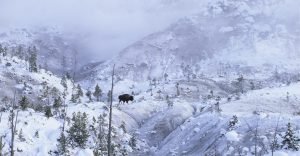
An older bull often ranges far from his home herd. Yellowstone Park, NPS.
Noble fathers Defend
For most of the year, except during breeding season, the big bulls are often found at some distance from the herd. Nevertheless, they stay watchful.
Buffalo bulls are born with a strong sense of responsibility.
They keep an eye on predators—such as the wolf packs of former days that followed the herds.
Lewis and Clark wrote about the buffalo herds “and their shepherds, the wolves.” While the wolves did not usually attack healthy buffalo, they often killed a lone injured buffalo hanging off to the side.
The bulls paid little attention to the wolves unless they were threatening the herd.
Then the “noble fathers,” as they’ve been called, moved quickly to protect mothers and calves.
I saw those “noble fathers” in action once myself. Our kids were teenagers then and with friends, we were riding horseback in the North Unit of Teddy Roosevelt Park.
We were about 15 riders, talking and laughing—so we probably looked like trouble as we came trotting over a hill.
There below us in a broad valley, a herd of about 60 buffalo were spread out grazing. They looked up and started to run, alarmed by our sudden appearance.
We pulled in our horses and paused to watch.
They didn’t run far. The big bulls stopped in an open area and formed a tight circle facing us, shaking their massive heads. Cows and calves took to the inside behind them.
Here’s how Colonel R.I. Dodge, described the behavior of bulls reacting like this in his 19th century book, Plains of the Great West.
“The bulls with heads erect, tails cocked in air, nostrils expanded and eyes that seem to flash fire, walk uneasily to and fro, menacing the intruder by pawing the earth and tossing their huge heads.”
Our modern-day buffalo bulls reacted in just that way—flashing fire, pawing the earth, shaking their heads in fury. Plainly, they were in a defensive mode that they all understood—the bulls ready and eager to take us on. The calves well-hidden and protected.
We understood them, too. It was clear they intended to fight if needed.
As we paused to watch, we were delighted to think that—for over 100 years, this very herd had lived safely inside a national park, without any large enemies to fear. No wolves nor grizzly bears nor hunters.
Yet these “noble fathers” stood ready to fight us off and protect with their lives the young calves and their mothers, just as their ancestors did long ago when real enemies threatened. No hungry wolves would have broken through their defenses that day!
We skirted far around and let the bulls think they had stood off our attack.
In an unusual rescue of long ago, a Blackfeet Indian reported seeing a young buffalo bull charge a grizzly bear that had attacked a heifer.
The grizzly was lying in wait, hidden by a trail near a creek when a small bunch of buffalo trailed down to drink. Led by a young heifer, they walked down the bank in single file.
As the heifer passed under the clay shelf where the grizzly hid, he reached down with huge front paws and caught her around the neck, then leaped on her back.
With a loud snort, she struggled to escape.
Suddenly a “splendid young buffalo bull” came rushing down the trail and charged the bear, knocking him down.
They fought fiercely. The grizzly tried to grab the bull by the head and shoulders, but could not hold him.
The bull slashed furiously with his heavy horns.
Blood gushing from mortal wounds, the bear tried to escape, but the bull would not let him go. He kept up the attack until he had killed the bear.
Even then he continued to gore and toss the bear’s carcass off the ground. He seemed insane with rage.
The Blackfoot hunter—who was also hiding near the trail—was much afraid he’d be discovered and attacked too. Finally, to his relief, the bull dropped the carcass and went off to join his band.
Ernest Thompson Seton, a Canadian writer, reported in Lives of Game Animals that “when calving, a buffalo cow can fight off one or two wolves. But if more attack, she calls for help.
“Her loud angry snort will quickly bring the bulls to her aid.”
When hunting, Native hunters preferred to kill cows and young bulls, for better, more tender meat than they’d get from the tough older bulls. But first they had to get past the big bulls that protected the outside of the herd.
A white hunter who joined the annual Miami hunt in Kansas in August 1854 explained how the Miami Natives reached the animals they wanted.

Big bulls took to the outside of herd when attacked, protecting cows and calves in center. CM Russell.
“They shoot down several bulls. As a gap in the line is thus made, they dash their ponies through the breach, conforming speed and direction to that of the herd.
“Gradually working toward the center, they find the cows, calves and two-year-olds, thus securing the finest robes and choicest meats.
“When their revolvers are empty, for only revolvers and bows and arrows can safely be used in this mode of killing, they worm their way out of the herd in the same manner as they entered.”
In blizzards and fierce storms, too, observers say, the large bulls form a triangle facing into the wind and shield cows and calves from wintery blasts.
Breeding Season: When big Herds Come Together
During rut, the late July and August breeding season, when large herds came together—and still do in places with large herds like Yellowstone Park—the buffalo relationships “embrace attraction, rejection, acceptance, competition and cooperation within and between the sexes,” according to Professor Lott.
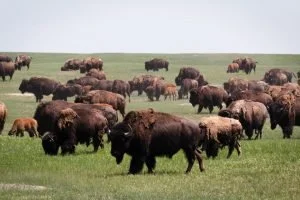
At National Parks, larger herds come together during breeding season in late July and August. Badlands National Park, SD, photo by Stephen Pedersen.
Lott writes that these relationships, though intense, are short-lived.
As young boy Lott grew up in sight of buffalo every day on the National Bison Range in Montana. He was born there in 1933—the same year as White Medicine, the most famous white buffalo of all time, who lived there all his 26 years.
He was very familiar with what he called the buffalos’ “social behavior, too marvelous a tale to go untold.”
Lott describes the chaos of breeding season. In rut, he says, the major dominant bull seeks out a cow that is nearly ready to breed, and “tends” her for a day or two, staying close and chasing other bulls away.
After she is bred, he finds another cow. If a rival bull is tending that cow, the dominant bull chases him off if he can, and takes over.
If he can’t, but persists, they fight until the battle is settled.
Two big bulls will fight furiously, slamming heads, battling for dominance. But most of their interactions are peaceful, as all know their rank order and tend to accept it.
The weaker, more submissive bulls give up easily and wander away. They know they can’t win—maybe they’ve battled that tough bull before.
The winner recognizes the other’s surrender and without wasting any more energy, lets him go.
Pecking order sets Buffalo Rules
Every buffalo knows where he or she stands in the herd’s ranking order. Each defers to those with higher ranking, and takes advantage of those with lower rank, pushing them away from what are deemed the tastiest grasses.

Each animal knows where he or she stands in the herd’s pecking order. Photo by Mana2580.
It’s called the “pecking order,” enforced by all. Each individual has a strong sense of where he or she stands in the herd, and accepts and respects that pecking order.
Regardless of how they are related, each of the females is in a dominant or submissive position to each of the others. A calf ranks with its mother.
In field research for his doctorate at the University of Wisconsin, Tom McHugh spent three months studying the ranking or “pecking” order of 16 buffalo in a Jackson Hole Wildlife Park near Yellowstone.
McHugh identified each buffalo, naming them by their horns (“Ring,” “Straight,” “Uneven”), their hides (“White Hump,” “Dark Hump,” “Scar”) or facial features (“Thin”). He got to know each individual and gave each a name and number—with a dab of paint when necessary, especially for the yearlings and 2-year-olds, which were harder to distinguish from each other.
When all were clearly identified and he could tell them apart, McHugh began charting their interactions.
Lacking sufficient grazing that winter, the buffalo were fed hay. As the hay wagon dropped its load each morning, the rankings were clearly revealed.
The main dominant bull strode to the first pile of hay, pushing all others away, shaking his head threateningly. The others moved off with scant protest to another pile—where they jostled the more submissive ones there.
Before long that first bull saw a newer, better pile of hay, and moved aggressively to claim it.
Three cows, already eating there stepped away quickly, jostling each other for position at the next best hay pile.
After a short time, the dominant bull moved on to a pile of hay he perceived as better, again chasing away subordinates. Usually he was treated respectfully—the more submissive ones simply moved away.

Big bulls eat their fill before allowing others to reach tasty hay. Photo by F Berg.
Typically, he ate there only a short time before moving again and displacing other buffalo—who displaced and jostled others and moved down one pile or more.
Meanwhile the 2nd and 3rd ranked animals moved up behind Number 1, displacing those of lower rank.
And so it went, from one pile to the next—the bigger, more aggressive buffalo displacing lower levels. However, they invariably showed submissive behavior to those of higher rank.
McHugh reported that Bull 6 dominated Bull 5, who dominated White Hump, who dominated Scar and all the way down the line to Yearling Heifer1B, the lowest-ranking animal of all.
Unfortunately for her, Yearling Heifer1B was subjected to head butts and horn prodding from all the other buffalo. She dared not retaliate against any of them.
Satisfied that he had discovered the truth of hierarchy for his book, “The Time of the Buffalo,” McHugh concluded: “Research showed that, far from being an arbitrary collection of similar animals, this society of buffalo was organized into a complex and discernible order of rank!”
McHugh also reported that rankings were disrupted with the birth of new calves, or when a new individual joined the herd, or young bulls began to assert themselves over previously dominant cows.

Rankings are disrupted when new individual joins the herd or young bulls begin to assert themselves. Photo by Richard Lee.
With such interruptions, a new hierarchy took over. Then, after things settled down again, each individual quietly accepted the new rankings.
Indeed, as Lott attests, such buffalo herd relationships are “too marvelous a tale to go untold.”

Saving Buffalo From Extinction—Part 2
June 12, 2024
Much has been written through the years about the role that noted conservationists from the east played in pulling bison back from the brink of extinction.
But Ken Zontek, buffalo historian, raises an interesting point in his book. He says not much attention has been paid to westerners who actually kept the young calves alive.
by Francie M. Berg
First published May 26, 2020
Charles Jesse “Buffalo” Jones started out as a commercial hide hunter on southern buffalo ranges.
His life adventures took him from his home in Kansas to the frozen Canadian North and the steaming jungles of Africa.

Buffalo Jones was a flamboyant speaker, a dreamer, and an entrepreneur who risked his profits over and over in buying, selling and shipping buffalo.
He prospered and suffered as a farmer, buffalo hunter, town developer and rancher. An expert roper, he captured calves in Texas and New Mexico. And, as a friend of President Teddy Roosevelt through the new American Bison Association, he was appointed as the first Superintendent of Yellowstone Park, in charge of restoring that depleted buffalo herd.
His greatest contribution was—not only capturing and raising a profitable buffalo herd—but finding ways to buy and sell buffalo and ship them across North America to help start new herds.
As a child, Jones caught and tamed small animals. He made his first money by capturing and selling a squirrel. That “transaction” Jones said “fixed upon me the ruling passion that has adhered so closely through my life.”
Jones said that he conceived his buffalo rescue plan in 1872.
He said he had killed “thousands of buffalo” in his hunting days and he regretted it.
“I am positive it was the wickedness committed in killing so many that impelled me to take measures for perpetuating the race which I had helped almost destroy.”
Filled with remorse, he set aside his big buffalo rifle, gathered some of the last wild buffalo calves and committed himself to helping the buffalo survive and thrive throughout North America.
He bought buffalo from as far north as Winnipeg in Canada and sold buffalo across the North American continent to help get parks and private owners started.
According to Ken Zontek, in Buffalo Nation: American Indian Efforts to Restore the Bison, during the last days of the wild buffalo, Buffalo Jones and his assistants went four times out to the buffalo ranges from his ranch near Garden City, Kansas, down into the Texas Panhandle, and captured 60 buffalo of all ages. Not all, however survived, or made the trip home.
Jones was a flamboyant speaker and told entertaining tales of those trips—roping buffalo calves, grabbing their tails, and hand-throwing them.
He explained to his biographer, Henry Inman, that on his first calf-catching expedition he had to protect his charges from wolves that closed in on the calves he had thrown and tied.

With a buffalo calf under each arm, Buffalo Jones kept the Texas wolves at bay until the supply wagon arrived. Sketch by J.A. Ricker from Buffalo Jones’ 40 years of Adventure.
Jones could not pause while he worked to catch as many calves as possible, he said, so he left an article of clothing on each calf to warn away the hungry wolves.
“Half-naked and burdened by a calf under each arm,” Jones then rode back to aid his captives. Finally, his support wagon, furnished with pails of milk, arrived and saved the day.
Emerson Hough, accompanying Jones’ second expedition, provided a vivid description of Jones’ capture method. “Up came his hand, circling the wide coil of the rope. We could almost hear it whistle through the air. … In a flash the dust was gone, and there was Colonel Jones kneeling on top of a struggling tawny object.”
During that buffalo-saving trip, Jones, like Goodnight, was “compelled to kill” a ferocious mother buffalo with his revolver. “An unwished result and much deplored, for we came, not to slay, but to rescue,” wrote Hough.
Jones successfully captured and mothered up many calves with milk cows, brought along each time for that purpose.
This usually involved an initial fight until the calf and cow grew attached to each other during the long trip from Texas back to Kansas.
Buffalo Jones’ last two calf-catching expeditions in 1888 and 1889 proved noteworthy for a couple of reasons.
First, Jones roped adult buffalo and tried to drive them home—unsuccessfully, however. Jones explained that the grown buffalo “took fits, stiffened themselves, then dropped dead, apparently preferring death to captivity.”
Many of the 60 he roped died, both calves and adult buffalo.
Second, it was on this expedition that he claimed he roped the last wild buffalo calf of the southern range.
“I whirled the lasso in the air … [and] laid the golden wreath around the neck of the last buffalo calf ever captured.”
Zontek notes that Jones—like the other rescuers of buffalo—was a buffalo hunter and a westerner. He saved buffalo near the ranch where he worked and lived as well, as making calf-hunting trips farther afield.
Like the others, Buffalo Jones worked hard to make a living. He saw nature as something beautiful, created to serve humankind.
The Buffalo Jones’ herd numbered 50 by 1888.
That year he had a chance to purchase 86 Canadian Plains buffalo originating from the herd of Tonka Jim McKay. Jones willingly paid $50,000, an average of $582 each.
Shipping them from Winnipeg to Kansas proved difficult, however, and added to the expense. Of the first thirty-three he cut out to drive to the railroad, a number of buffalo broke and ran back to the herd.

Rounding up and shipping 86 buffalo from Winnipeg to Kansas proved a challenge.
Three more were killed by others in the railroad car near St. Paul. Thirteen escaped when unloaded for water in Kansas City and stampeded through town.
Shipping the remaining buffalo home to his ranch at Garden City, Kansas, proved a challenge, but once there, they increased rapidly.
He soon owned over 150 head and began selling buffalo to zoos, parks and private individuals.
Like Charles Goodnight, Jones experimented with crossing buffalo with cattle. He also learned what did and did not work from Goodnight. Often the cross-breds were not fertile, and most did not show the desirable traits he wanted.
By 1895 Jones was deep in financial trouble.
Forced to sell his ranch and holdings, he dispersed his buffalo. Some went to Pablo and eventually back to Canada. Others shipped to west coast locations.
As a friend of President Theodore Roosevelt through work with the American Bison Society, Buffalo Jones requested and was granted an appointment as the first superintendent and game warden of Yellowstone National Park.
There he led the effort to rebuild the remnants of the Yellowstone buffalo herd, with a mix of buffalo from numerous sources. From long experience, he knew exactly where to find viable buffalo herds and how to handle them.
Unfortunately, Jones was not so skilled working with employees and eventually lost favor and his ideal job.
He continued lecturing on his experiences with buffalo and his African adventures, but gained a reputation for exaggeration, and even hints of shadiness in his dealings.
Pete Dupree kept his buffalo herd intact
In what is now South Dakota, Fred Dupris (also spelled Dupree) watched the buffalo disappear from Dakota Territory.
The buffalo had migrated farther west because of settlement in the eastern Dakotas and hunting pressure throughout the territory during the late 1860s. For 15 years they were gone from Dakota Territory.
The son of a distinguished French-Canadian family in Quebec, Fred Dupree arrived in South Dakota in 1838 and prospered through a variety of ventures, including fur trading and cattle ranching, according to Dave Carter, director of the National Bison Association.

Fred Dupree, Fur Trader and cattle rancher on the Cheyenne River. SD Historical Society.
He married a Minneconjou Sioux, Mary Ann Good Elk Woman, and set up a trading post in a pleasant wooded area along the Cheyenne River within the Great Sioux Indian Reservation, just at the point where Cherry Creek flowed into the Cheyenne.
As a Native American woman, Mary Ann held rights to run cattle on the reservation, and they built up a herd of 200 range cattle, along with running the prosperous trading post.
There they raised a large family, with 10 children.
Fred Dupris became one of the state’s leading pioneers. As each of their children married and started a family, he and his wife built another log cabin in the cottonwood trees along the river.
Late in his life, when Fred Dupree was in his 70s, amazingly, the last 50,000 buffalo migrated back onto the Great Sioux Reservation.
It was December of 1880. The Duprees immediately notified relatives and friends and prepared for a winter buffalo hunt. They also invited the young missionary Thomas Riggs from the Oahe Mission, just east of the Missouri River, to join them.
Riggs wrote a detailed description of the three-month buffalo hunt, so we have a first-hand, documented account. (See “Buffalo Heartbeats Across the Plains,” Winter Hunt in Slim Buttes, by FM Berg, page 26.)
That winter of 1880-1881 they spent in tepees and tents in the Slim Buttes was one of the coldest, heaviest-snow winters in years, Riggs said.
Soon after—that spring or the following one, in 1881 or 1882, Pete Dupree and some of his brothers, and likely sisters, too, went out to rescue buffalo calves.
They likely drove a buckboard wagon pulled by a team of horses, with outriders leading pack horses for carrying home additional buffalo meat, always much needed by their many families.
Until 1883, plenty of buffalo still grazed there on the Great Sioux Reservation—but almost nowhere else.
Fred Dupree, the old fur trader is historically credited for “sending out his sons” to capture the buffalo calves. However, by then he was an older man in his mid-70s and stayed home by the fire while his family went out on their last winter hunt. His sons were grown men.
One might imagine the old trader telling visitors that he sent out his sons to rescue calves, even if it didn’t quite happen that way. Again, conflicting stories abound.
A more likely scenario may be that Mary Ann Dupree and her sons and daughters hatched the details of their plan to rescue buffalo calves during their long three-month buffalo hunt.
Mary Ann was the woman who suggested the missionary Thomas Riggs join them and share their family tent in the Slim Buttes. She was very resourceful and known by her husband and others as “a good woman.”
In the extreme cold of that winter they spent many hours together in the tent and were, naturally, very familiar with the Native Americans’ deep concerns about buffalo soon becoming extinct.
After 15 long years of heartbreak over their disappearance, the buffalo had returned to them.
They had migrated right into the Duprees’ own backyard, so to speak. If these Native people failed to help them now, who would?
Some historians suggest that the Duprees brought their buffalo calves home in their wagon in February 1881, at the end of that long, cold hunt in the Slim Buttes.
But there’s no logical way that could have happened.
First of all, wild nine- and ten-month-old buffalo calves would have been much too large and aggressive in February to be handled and would never have gentled well.
Second, there was no extra room in the wagons. The Dupree wagons carried full loads of hides and meat—no room for lunging, brawling half-grown calves! The long trip home through deep crusted snow with heavily loaded wagons was difficult enough without trying to wrestle big calves.
Third, Riggs made no mention of hauling buffalo calves home in his summing up of the three-month hunt’s successes.
Besides, until 1883, plenty of wild buffalo still grazed there on the Great Sioux Reservation—but almost nowhere else within riding distance.
Another story, that their father Fred Dupree picked up the calves on the Yellowstone River in earlier years, also seems unlikely. The fragile calves would hardly have survived that long trip home without milk and good nourishment. Many such captured calves died of starvation long before they ever reached a home ranch.
Most likely the location was the south fork of the Grand near the juncture where the north and south forks flow together or within a few miles.
South Dakota historians writing for 4th graders have identified the south Grand River as the site where the Duprees found their buffalo calves. That was only a couple of days drive by wagon from their home on Cherry Creek—around 60 miles. [1. South Dakota State Historical Society, “Buffalo in South Dakota, Unit 3, Lesson 3: Preservation of the Buffalo,” The Weekly South Dakotan: South Dakota Treasure Chest for 4th-Grade History, www.sd4history.com.]
Also, the Grand River is identified as the place where Pete caught his five calves by Wayne C. Lee, writing in “Scotty Philip, the Man Who Saved the Buffalo.” [2. p157 and p225. Caxton 1975.]
That Pete Dupree immediately found fairly gentle range cows and quickly “mothered up” his buffalo calves was another major achievement. In this effort he may well have had help from his mother and sisters—and thus avoid the typically high death loss of “rescued” buffalo calves.

Buffalo calves often died of malnutrition before they could be successfully “mothered up” with a range cow. SD Game, Fish, Parks.
Mothering up—trying to coax half-wild range cows to accept the strange-smelling calves, and the lanky youngsters to nurse and bond with the low-slung cows—could not have been easy. But once accepted by their adoptive moms, the gangly buffalo calves grazed contentedly on lush reservation lands, and within a few years, began raising calves of their own.
While the other four buffalo rescuers engaged in considerable buying and selling of buffalo, even donating many buffalo for new public herds, Pete Dupree kept his growing buffalo herd intact, and allowed them to increase naturally on the Great Sioux Reservation.

Pete Dupree kept his growing buffalo herd intact grazing and multiplying on the Great Sioux Reservation. Photo by Stephen Pedersen.
He neither sold nor purchased buffalo. As buffalo, they required little or no care. They just naturally multiplied. And occasionally, a stray buffalo joined his herd.
Also, from time to time they interbred with range cattle, resulting in the crossbred animal, then called “cattleo.”
For ten years Pete’s herd increased. Then in 1898 Pete Dupree died.
Scotty Phillip took over the bison rescue
His younger sister’s husband, Douglas Carlin handled the sale of his estate. In a highly fortunate move, Carlin found the right buyer for Dupree’s buffalo.
James “Scotty” Phillip was born in Scotland in 1858 and traveled throughout the American West panning gold, working as a scout, and ranching in Wyoming, before marrying Sarah “Sally” Larribee, a Lakota Sioux, in 1879, according to Dave Carter, of the National Bison Association.

Like the Duprees, Scotty and Sally Philip intended to do what they could to save the buffalo from extinction.
They settled down near Fort Pierre in South Dakota in 1882, prospering in the cattle business, running cattle on the Great Sioux Reservation, under Sally’s Indian allotment, as well as on privately owned lands the purchased.
When the chance came to buy Pete Dupree’s buffalo for $10,000, Sally urged her husband to buy.
“We must not let the buffalo die. My people might need them again,” Sally Philip is quoted as saying.
It is likely, she was thinking not only of Lakota needs for food, shelter and clothing, but also their spiritual and emotional ties to buffalo.
Scotty agreed that helping save the buffalo was a way he could support his Native friends, who often were not treated well.
Philip sent six cowboys to round up the Dupree herd and drive them the 100 miles to his pasture. His nephew George Philip, a budding lawyer, was pressed into service and later wrote about the difficult venture.
George Philip wrote of the formidable task in which he and the cowboys finally brought to the Philip pasture gate 83 buffalo, plus a number of cattalo.
They’d had to let go of the old renegade bulls that escaped from their several roundups.
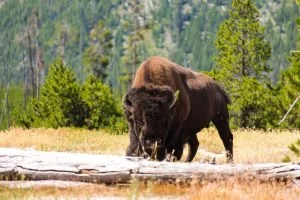
Philip’s cowboys had to let of old renegade buffalo bulls that refused to cooperate in the roundup. Later most were shot for their heads. Photo by Chloe Leis.
Philip declared the cattalo worthless and quickly sold or butchered them, according to his biographer, Wayne C. Lee, in “Scotty Philip: The Man Who Saved the Buffalo.”
He believed that buffalo were unique, and deserved to retain their natural traits. (This attitude prevails today among breeders, and is listed among the ethics policies adopted today by both the National Bison Association and Intertribal Buffalo Council. No cross-breeding, unless accidental. This is sometimes expressed as “let buffalo be buffalo.”)
The Phillips became willing and devoted buyers and protectors of the Dupree buffalo herd. Like the Duprees, they took their mission to save buffalo seriously. They intended to do what they could to save the buffalo from extinction.
When the U.S. government opened the Great Sioux Reservation lands in South Dakota for homesteading, Scotty Philip asked that 3,500 acres on the Missouri River bluffs north of Fort Pierre be set aside for grazing native buffalo.
Congress agreed and located the reserve just north of Philip’s own buffalo pasture, leasing it to him for $50 a year.
On the Missouri River bluffs his buffalo herd of several hundred head became a well-known tourist attraction. Special excursion boats brought visitors upriver from Pierre to view the rare and amazing buffalo ranging in the rugged badlands.
One day a delegation of Mexican officials from Juarez came to see the tourist buffalo. They laughed and declared the big bulls lazy and slow moving. Definitely unworthy of comparison with their own fiery Mexican fighting bulls, they thought.
Scotty Philip and his Fort Pierre friends took offense and challenged a bull fight.
This actually took place in January 1907 in the bull-fighting ring in Juarez.
Fortunately, Phillip’s nephew George was called on again to attend the two buffalo bulls shipped there, when a blizzard emergency kept Scotty home with his cattle. George described the Mexican bull-Buffalo fight in delightful detail for historical records. (See “Buffalo Heartbeats,”Mexican Bullfight, page 182.)
Native buffalo owners grew their buffalo herds
Thus, these five family groups are especially honored as having saved the buffalo from extinction.
Men received the credit from early historians for saving the buffalo, in the fashion of the times. However, women were much involved, as well, and are celebrated today.
Native American women went on all the big hunts and watched the great herds disappear. They despaired over the ruthless slaughter by commercial hunters with powerful, long-range rifles.
Women and children, too, undoubtedly helped to bottle feed calves, and coax the adoptive milk cows and half-wild range cattle mothers to bond with their gangly new calves.
The men “may have been considered ‘Buffalo Kings’ by their fellow ranchers, but it was the wives who should be remembered as ‘Buffalo Queens,’” says Susan Ricci, manager of the Buffalo Museum in Rapid City.
Modern historians rightly give the families a great deal of credit for saving the buffalo. Not just the men.
These were the five family groups who made special efforts to care for their buffalo herds and raised sustainable adult herds for many years:
Sam Walking Coyote and his herd purchasers Charles Allard and Michel Pablo in western Montana;
James McKay and neighbors in Manitoba, Canada;
Pete Dupree and his herd purchasers the Scotty Philips in South Dakota;
Charles and Molly Goodnight of Texas;
Buffalo Jones of Kansas.
Doubtless, other people were involved in raising buffalo for a time here and there. Nevertheless, the herds of these five flourished and eventually became the foundation for literally all the Plains buffalo herds populating the world today.
All were westerners, all hunted buffalo and all were ranchers.
The first three of these groups had Native American roots and knew well the cultural importance of buffalo in the lives of their people. They all held a deep cultural stake in survival of the Buffalo.
Rather than butchering or selling the increase, the Native families mostly grew their herds, multiplying and strengthening their numbers. They cherished the natural wild traits of the buffalo without trying to alter them. Cross-breeding, when it occurred was accidental, the result of cattle and buffalo sharing the same ranges.

Native American families grew their herds and cherished the wild traits of the buffalo without trying to change them. South Dakota Game, Fish and Parks.
The white ranching families, the Goodnights and Buffalo Jones, respected the natural world, cherished their buffalo and appreciated their own roles in preserving them. However, perhaps more than the others, both these non-Indian families hoped to reap economic benefits and engaged in much buying and selling of buffalo.
Also, both experimented with cross-breeding in the hope of developing hardier, more productive beef animals. This was generally unsuccessful, and today cross-breeding is discouraged and violates the Code of Ethics of both the National Bison Association and the Intertribal Buffalo Council.
Much has been written through the years about the role that noted conservationists from the east played in pulling bison back from the brink of extinction.
The work of William Hornaday, George Bird Grinnell, President Theodore Roosevelt and others of the American Bison Society was important in setting aside public lands for buffalo and providing long-term sustainability for public herds. They were visionary conservationists, and also had hunted buffalo.
But Ken Zontek, buffalo historian, raises an interesting point in his book. He says not much attention has been paid to westerners who actually kept the young calves alive.
He notes that, while conservation-minded people in the east put forth a valuable effort in founding wildlife parks and sanctuaries for long-term survival of the buffalo, they would have failed, had it not been for westerners who caught and saved calves in their own localities.
His observation is absolutely true.
Once the buffalo were thriving in viable herds, men and women from the east made sure they were safe long-term and multiplying in buffalo parks and sanctuaries throughout the United States.
However, if not for the five rescuing groups and their families caring for young starving calves in their own communities, the Plains buffalo would not have survived as a species.
Without them there’d be no buffalo alive today.
To a greater or lesser extent their vision involved the survival of an endangered species.
Their herds flourished and eventually became the foundation of all the Plains buffalo herds now populating the United States and Canada.
These are the families—with boots and moccasins on the ground—who kept the buffalo species alive at their lowest ebb.

Saving the Buffalo from Extinction—Part 1
May 12, 2024
Clearly, the buffalo were headed for extinction. No one seemed to care.
The “bottleneck”—as it’s been called—drew even closer each year after the last great buffalo hunt on the Great Sioux Reservation in 1883.
The low point came in the 1890’s, or perhaps later, around the turn of the century. That was when the “safe and protected” Yellowstone Park herd, estimated at 200, was suddenly decimated by poachers seeking trophy heads.
Fewer than 25 buffalo, well hidden in remote and rugged canyons, survived that slaughter in Yellowstone Park.
by Francie Berg
First published May 19, 2020
Clearly, the buffalo were headed for extinction. No one seemed to care.
The “bottleneck”—as it’s been called—drew even closer each year after the last great buffalo hunt on the Great Sioux Reservation in 1883.
The low point came in the 1890’s, or perhaps later, around the turn of the century. That was when the “safe and protected” Yellowstone Park herd, estimated at 200, was suddenly decimated by poachers seeking trophy heads.
Fewer than 25 buffalo, well hidden in remote and rugged canyons, survived that slaughter in Yellowstone Park.
The species was nearly choked off completely at that time. Even the few hundred remaining seemed destined to dwindle.
William Hornaday voiced his despair over the buffalos’ nearly-inevitable extinction in his 1889 book, “The Extermination of the American Bison.” He wrote:
“The wild buffalo is practically gone forever, and in a few more years, when the whitened bones of the last bleaching skeleton shall have been picked up and shipped East for commercial uses, nothing will remain of him save his old, well-worn trails along the water-courses, a few museum specimens, and regret for his fate.”

Hormaday despaired that ‘when the whitened bones of the last bleaching skeleton were picked up and shipped East’ the only memory of buffalo would be trails to water, regret for his fate, and a few specimens in museums. Photo National Park Service.
As head taxidermist at the Smithsonian Museum in Washington, DC, Hornaday worked hard to collect dead buffalo specimens. He believed it was his duty to help the nation’s most important museums show future generations how magnificent the buffalo had once been.
Difficulties in raising Buffalo
Some ranching families stepped in to save a few buffalo calves, but their efforts were scattered and uncoordinated. Likely most did not see themselves as important links in the void of trying to save an entire species.
Raising a viable herd became more and more difficult as years went by. Even if fragile young calves survived their initial crisis of bonding and grew to adulthood. Even if their saviors found adequate pasture not needed for other farming.
There was no market for buffalo. No one wanted to buy them. They were difficult to handle, and worst of all, they quickly outgrew their boundaries.
When too crowded, they simply broke through confining fences and caused havoc in the community. Angry neighbors waved pitchforks over ravaged crops.
No government program advocated their rescue. Even toward the end, no experts reached out to save the majestic buffalo.
When the owner of a small herd died or lost his land, the herd had to be disposed of—and usually quickly. The buffalo herd was multiplying fast and pasture boundaries were easily breached.
All too easily came the obvious solution—at the butcher shop. Slaughter the entire herd, when heirs could no longer handle the buffalo. End of problem.
But a few feeble glimmers of hope shown through.
Actually, there were five.
These five family groupings get the credit—and our gratitude—for establishing viable buffalo herds that grew and multiplied. They are:
1. Samuel Walking Coyote and herd purchasers Charles Allard and Michel Pablo in western Montana;
2. James McKay and neighbors in Manitoba, Canada;
3. Pete Dupree and herd purchasers, the Scotty Philips in South Dakota;
4. Charles and Molly Goodnight of Texas;
5. Buffalo Jones of Kansas.
Separately, these people brought buffalo back in significant numbers for survival—onto the western plains and grasslands where they have always thrived so well.
These were ordinary people—westerners, ranchers, even buffalo hunters—with boots on the ground. Or more specifically, in over half the cases—moccasins on the ground.

Separately, five family groups of ordinary people in their own communities captured wild calves, raised them into viable buffalo herds and brought the animals back from near extinction. Photo by Brian Miller.
The first three of these five family groupings had Native American roots. The last two were white ranching families.
Without them, buffalo would have gone the way of the passenger pigeon.
William Hornaday’s dire prediction could have proved true. The last whitened bones of the last bleached buffalo skeleton could have been shipped out for fertilizer.
Sam Walking Coyote’s trek over the Rocky Mountains
Samuel Walking Coyote of the Pend d’Oreille Indian Tribe in western Montana had no intention of raising buffalo—or of helping to save the species.
After all, he came from west of the Continental Divide—not the historic home of Plains buffalo.
But there he was with eight half-grown buffalo calves on the east side of the Rocky Mountains and a longing to return back home.
He wasn’t sure he’d be welcome. He knew he might already be in trouble with the Fathers at the Mission. But he hoped the calves might be viewed as a nice gift for them.
Walking Coyote lived with his Flathead wife on her reservation in western Montana.
There are several versions of Walking Coyote’s story. But as with most of the other heroes of this buffalo saga, he could neither write, nor read his own account of what happened.
In the summer of 1872 he decided to ride east across the Rocky Mountains on old Indian trails over the Continental Divide and spend the winter hunting buffalo in Montana’s
He made the trip and had a fine time hunting buffalo with Blackfeet hunters who scouted far up the Milk River close to and likely across the border into Canada.

Orphaned calves bonded with the horses and followed the Blackfeet hunters home. Photo by Chris Hull, SD Game, Fish, Parks.
After one hunt, eight orphaned buffalo calves came into their camp and bonded with the horses. They stayed around the rest of the winter and ate hay with the Native horses.
During this time, Sam Walking Coyote fell in love with a young Blackfeet woman from the tribe, and arranged with her family to marry, ignoring the fact he already had a Flathead wife.
Two wives were permitted in both tribes. Often it happened through necessity, as when an impoverished widow was brought into her sister’s family for protection.
But Walking Coyote knew very well that the Jesuit priests at St. Ignatius Mission would be angry to discover his second wife.
He longed to go home, and was persuaded by a friend that the buffalo calves would make a fine gift for them, as a way to make amends.
So, one pleasant spring day, after some of the snow had melted from the high trails, Walking Coyote and his new wife set off west to cross the Rocky Mountains with their little caravan, several pack horses, dried buffalo meat and the eight buffalo calves.
It was hundreds of rugged miles travelling over and up and down the Continental Divide.
The trail they followed was long and treacherous, up one steep mountain pass and down the next, alternately leading and driving their little herd, scrambling over rocks and fallen timber. They waded through icy rushing rivers and deep snow banks.
Sometimes they tied the smaller calves onto the backs of horses, when they were too tired to walk.
Grass for the livestock became scarce and there was no game to eat. Two of the calves died along the way.
At long last they came out on the west side of the mountains and made their way down onto the Flathead reservation.
A man named Que-que-sah is quoted in an interview by the 1942 W.P.A. Writers’ Project, as saying, “I was in the village St. Ignatius that day in 1873, when [Walking Coyote] rode in with his pack string. He had four buffalo calves on pack ponies. I recall that they were rather small. One, in particular, was very young and weak.”
As it turned out, the priests did not look with favor on Walking Coyote, his new wife, or even the gangly buffalo calves. They scolded him severely, and he was punished by his first wife’s tribe.
Banned from the mission, he moved his buffalo farther on down the valley. There they became pets and objects of great interest to the Native people.
“We were all greatly interested in the welfare of Samuel’s calves,” recalled Que-que-sah. “I think that every Indian on the reservation looked upon this little herd as the last connecting link with the happier past of his people. I know we all protected them, wherever they were grazing.”
The Native community grew committed to the little herd’s survival, writes Ken Zontak in “Buffalo Nation.”
Interestingly, the west side of the Continental Divide was not the natural home of Plains buffalo. Historically buffalo lived only east of the Divide and did not come across the Rockies.
But the six calves thrived there on the rich mountain grasses and multiplied.
By 1884, Sam Walking Coyote owned a herd of 13 tame buffalo.

Pride of the community: Walking Coyote’s small herd wandered unmolested on the Flathead Reservation. Photo by SDGFP.
“The small herd wandered about the Flathead Reservation unmolested and caused much excitement during calving time,” wrote Zontak.
“Their bison served as the pride of the community, with Sunday observers visiting after church at Saint Ignatius to view the icons of a bygone era.”
However, as the herd increased, the huge animals broke down fences and destroyed crops. They were becoming a nuisance to Sam’s neighbors.
He decided to sell them to Charles Allard and Michel Pablo, friends of his and ranchers in the valley, who were interested in raising buffalo.
The Canadian Winnipeg Tribune stated that Walking Coyote had a prospective Canadian buyer, but negotiations broke down when he named his price–$250 a head.
The Winnipeg newspaper reported, “Donald McDonald, the last man to represent the Hudson’s Bay company on United States territory, entered into negotiations to purchase that little herd of the last plains buffalo remaining alive.
“But C.A. Allard and Michel Pablo, two Montana ranchers, made a deal with Walking Coyote, at $250 a head for the animals.
“Walking Coyote insisted on having actual money. He refused to accept a cheque. Allard and Pablo were busy counting out the greenbacks into piles of $100, each of which was placed under a stone, when they saw a mink.
“Instantly, Walking Coyote and both the ranchers went after the mink, and for some minutes forgot the piles of money, to which they hurried back, to find it safe, with a lone Indian looking at it with covetous eyes,” according to the Winnipeg Tribune (Dec 22, 1922).
Both the new partners had Native American mothers, and Pablo’s wife was Salish. They had rights to run buffalo free on Indian lands.
Pleased with their purchase of buffalo, they bought 26 more, along with 18 cattalo—half buffalo, half cattle—from Buffalo Jones of Kansas.
A healthy herd, it multiplied and by 1895 they owned 300 head of buffalo grazing them on the same free Indian Tribal ranges.
Then Allard died unexpectedly at age 43, and the herd was divided. Allard’s half went to several buyers. Some went to Yellowstone Park to begin replenishing that herd.

Michael Pablo and his Montana buffalo herd. It soon multiplied to over 300 head—and more.
By 1906, with his herd doubled again to 300, Pablo learned the Flathead reservation was opening to homesteaders. He’d lose his free range there. He offered to sell the whole herd to the US government for $200 per head, but Congress turned it down as too expensive.
Eventually he was able to sell his entire herd—redoubled again to over 700 head—to the Canadian government. Price: $250 each including freight by rail.
James McKay, a Canadian Métis hunter
Frequently, James McKay, also known as Tonka Jim, joined the twice-yearly Red River Métis hunts.
Living near Winnipeg, Canada, Tonka Jim McKay began his career working for the Hudson Bay fur trading company, as did his Scottish Highlander father. His mother, Margarete, was Métis.

Tonka Jim McKay enjoyed wearing the popular Metis garb: Hudson Bay coat with hood attached, tied at waist with colorful sash. Voyageur Capote Coat with Nancy Gouliquer, Manitobamuseum.ca.
He served as postmaster and clerk, managed small trading posts mostly in what are now southwestern Manitoba and southeastern Saskatchewan, and established two Hudson Bay posts in US territory.
Moving into Manitoba politics, he represented the Métis people and helped them negotiate treaties. He served Manitoba as president of the Executive Council, Speaker of the Legislative Council and Minister of Agriculture.
With his knowledge of the prairies and indigenous people, McKay also excelled as a frontier interpreter and guide. Often he wore the popular Métis attire—a hooded blue capote with pants of homemade wool, moccasins and a colorful sash.
With each buffalo hunt, McKay noted his friends were going farther west and south into Montana with their Red River Carts to find buffalo herds.

Tonka Jim McKay enjoyed wearing the popular Metis garb: Hudson Bay coat with hood attached, tied at waist with colorful sash. Voyageur Capote Coat with Nancy Gouliquer, Manitobamuseum.ca.
With the massive kills of their large Métis parties, the Plains buffalo were quickly disappearing from Canada, as well as the northern states.
At the same time the constant hunting pressure pushed the Wood Buffalo farther and farther north in Canada.
McKay became alarmed at the scarcity of buffalo. On an 1873 Métis hunt he captured three calves with the help of friends and the next year, another three, bonding them with nurse cows on his Deer Lodge ranch some 28 miles west of Winnipeg.
He purchased a few more calves from Native hunters who went west to hunt and returned through Winnipeg.
In about 1877 McKay sold five calves to Colonel Sam Bedson, a penitentiary warden, for $1,000. Bedson’s buffalo thrived. By1888 he owned nearly 80 full-breed buffalo and 13 half-breeds.

Exhibition herd in paddock at Banff National Park, Alberta.
Unfortunately, in 1879, just as his buffalo herd was gaining some natural increase, Tonka Jim McKay died at the age of 51.
After his death some of McKay’s buffalo went to the Canadian government. Others went to another neighbor who then donated all of his 13 buffalo to Rocky Mountain Park in Banff for a special exhibition herd.
Charles and Molly Goodnight in Texas panhandle
When Charles Goodnight was 11, he moved to Texas from Illinois with his parents—who got caught up in the ‘Texas Fever’ of the 1840’s.
He fit right in, growing up on the new frontier, and took on several ranching positions before settling down as a rancher himself.
One of these jobs was trailing Texas cattle north to market. With drover Oliver Loving, he became well-known for blazing the Goodnight Loving Trail to the railroads in Cheyenne, Wyoming.
The trail proved a success. Over the years hundreds of thousands of cattle were driven up the Goodnight Loving Trail from the Southern Plains to Cheyenne and then shipped by rail to eastern markets.

Charles Goodnight, a prominent cattleman of the Texas Panhandle, “approached greatness more nearly than any other cowman of history,” according to writer J. Frank Dobie.
Goodnight also killed his share of the wild buffalo that covered the Texas plains and competed with cattle for grass.
One day while buffalo hunting, he discovered that very young buffalo calves tired quickly and dropped behind when the herd stampeded. He decided to capture some of them.
“The first time I went out to get buffalo calves, I moved them up a little until three of the calves fell behind. I cut them off and they followed the horse home and into the corrals,” he recalled years later. “When night came I roped them and put them to their foster mothers, Texas cows.”
A few days later he cut out two more in the same way, but thought he needed one more.
“I wanted six, so I went out again and found one calf about twenty-four hours old. I scared the cow off some distance, and put the calf on my horse. But the cow returned and attacked me so viciously that I had to kill her to save my horse. I felt badly over it then, and the older I get, the worse I feel about having to kill that cow.”
Goodnight mothered up the six calves with range cows, and when they were eating well he left them with a friend, who agreed to care for them on shares for half the profits.
But when he returned, he was disappointed to find the friend “got tired of the business and sold out, and never even gave me my part of the money.”
In 1870, Goodnight married Mary Ann ‘Molly’ Dyer, a teacher from a small town west of Fort Worth, and began building up his own ranch in the new country of the Texas Panhandle.

Goodnight credited his wife Molly for renewing his interest in raising buffalo calves.
Molly realized the buffalo were fast disappearing and urged her husband to help save them.
He gave his wife credit for renewing his interest in raising buffalo.
“In the spring of 1879—to be exact, May 15th—at my wife’s request, I started out to look for some young buffalo. At last I found a few younger ones in Palo Duro canyon, and roped them from horseback.
“The month following, W.W. Dyer, my wife’s brother, caught two young females. From this start we have now a herd of 45 purebred buffaloes”
By then Goodnight owned many cattle and claimed 60,000 acres of pasture. He set aside 600 acres for a fenced buffalo park.
Together Charles and Molly Goodnight continued building up the first Texas Panhandle ranch, the JA Ranch, in the Palo Duro Canyon of the Texas Panhandle.
There they lived “the good life” in a Victorian-style home, and Mollie cooked for and entertained heads of state, hungry cattlemen and cowboys, as well as the Comanche leader Quanah Parker.

Mollie Goodnight taught children in the bunkhouse. The cowboys slept there at night, and she moved their things aside for school during the day. The house had electricity and sheltered hundreds of ranch workers and cowboys over the years.
Mollie Goodnight taught children in the bunkhouse. The cowboys slept there at night, and she moved their things aside for school during the day. The house had electricity and sheltered hundreds of ranch workers and cowboys over the years.
Molly Goodnight was known as compassionate, one of the few women living in the Texas Panhandle. She is given much credit for saving the original southern buffalo in their purest form.
At one point the Goodnights obtained two buffalo—a yearling and a two-year-old—from Colonel B.B. Groom’s ranch and sent two cowboys to pick them up.

Palo Duro Canyon of the Texas Panhandle, where the Goodnight buffalo herd hid out for years.
One of the cowboys, Mitch Bell, “goodhearted veteran of the Palo Duro,” recalled that they took a camping outfit, wagon and horse feed, since they would be out three nights.
Tied to the wagon was Old Blue, a ranch steer.
Bell said they roped and dragged the two buffalo up and necked them tight to Old Blue.
“Then we turned Old Blue loose, and he was the maddest steer I ever saw. He jerked the little one down, drug him a long-ways, and I thought was going to kill him, sure. But finally he got up, on the same side with the other buffalo, and he stayed there all the way back to the ranch.”

A pair of Goodnight bulls with authentic southern genes. Caprock Bison Release, Earl Nottingham.
Goodnight began experimenting with cross breeding in 1884, crossing buffalo with Polled Angus and Galloway cattle, and developed a herd of sixty cross-breds he called cattalo.
Their buffalo herd continued to increase and by 1910 was reported as totaling 125. On January 1, 1914, the total was 164, of which 35 were bulls, 107 were cows, and 22 were calves. The highest number the Goodnights reported was about 250 head.
The Goodnights donated and sold buffalo directly from their herd to Canada, Germany, Nevada, New Hampshire, Kansas, Oklahoma, Texas, Montana, New Mexico and New York. The genetics of the few remaining buffalo were becoming quite mixed.
Many of their donations to zoos and parks helped to start new buffalo herds.

Buffalo vs Bison– What Shall We Call Them?
April 12, 2024
What shall we call this magnificent monarch of the Plains—buffalo or bison?
Some people are adamant: the term buffalo correctly refers only to water buffalo in South Asia and Cape buffalo in Africa. We are simply wrong, misinformed, or ignorant to even think of calling the American bison—Buffalo.
by Francie M. Berg
First published May 5, 2020
What shall we call this magnificent monarch of the Plains—buffalo or bison?
Some people are adamant: the term buffalo correctly refers only to water buffalo in South Asia and Cape buffalo in Africa. We are simply wrong, misinformed, or ignorant to even think of calling the American bison—Buffalo.

Magnificent monarch of the Plains surveys his lush grassy range in the Badlands National Park in South Dakota. National Park Service.
Amy Tikkanen, writing in the Encyclopedia Britannica lays it all out. In her world it comes down to “Home, Hump and Horns.” Bison have one set, and buffalo the other.
But not so fast.
Many people who know the science simply prefer the term buffalo. I think most of us in the west—where the buffalo still roam in rather large numbers—do prefer it.
It rolls off the tongue in a friendlier way.
Yes, in scientific usage we agree, it is bison—as is bovine, equine and canine.
My husband Bert, a veterinarian, often used those terms when explaining treatments.
But do we call the cow, horse or dog those scientific names—bovine, equine and canine—in everyday talk?
One happy dog—or is he a friendly canine? Photo by Eric Ward.
Of course not. We don’t even think of them, our beloved friends, that way, do we?
Historic use of Buffalo in America
The word Buffalo actually came from early French fur traders and trappers who called the animals les boeufs, a Greek word for “the beeves” meaning oxen or bullocks.
In that context both names, bison and buffalo, have a similar meaning.
Buffalo has a long history of being used in North America, dating from 1625 when first recorded—even before bison was first documented, in 1774.
Buffalo even has a verb form—to buffalo, meaning to overawe or bewilder.
Here in the west we are well aware that a number of our other species were misnamed by early visitors.
Like buffalo, these early names often stuck, and have become generally accepted into our language, even though they may not derive from their proper scientific origins.

A herd of antelope mingles with the buffalo on this range. SD Tourism.
For instance, our antelope is really a pronghorn. An American jackrabbit is a hare, not a rabbit.
Our elk is really a wapiti, while our moose is the same as the European elk. And American caribou are identical to domesticated reindeer in Europe and Siberia.
But that’s okay—we like it this way.
The American Bison Association has made attempts to persuade buffalo ranchers to call their livestock bison. It does seem to work well when ranchers sell meat.
Maybe we all need a bit of distance for that.
That’s not the issue.
Otherwise, calling them Bison seems to put these magnificent, iconic animals out there at some distance. There’s no heart in it.
In contrast, Buffalo seems a good, solid, friendly yet respectful name, with no formality separating us from these majestic animals.
You can put some love into it if you choose.
“Give me a home where the Buff-a-low roam, where the deer and the antelope play.”
“Buffalo gals gonna come out tonite–come out tonite–and dance by the light of the moon!”
Can’t do that with Bison.
That’s not really the issue, though.

“Oh, give me a home where the buffalo roam,” a song for all ages. Photo by Akshar Dave.
“Buffalo gals gonna come out tonite–come out tonite–and dance by the light of the moon!”
Can’t do that with Bison.
That’s not really the issue, though.
Confusion of ‘Home, Hump and Horns?’
I think we can all agree that the Encyclopedia Britannica item as written by Amy Tikkanen, sets the argument out scientifically and clearly. No wiggle room there.
“It’s easy to understand why people confuse bison and buffalo,” Tikkanen writes. “Both are large, horned, oxlike animals of the Bovidae family. There are two kinds of bison, the American bison and the European bison, and two forms of buffalo, water buffalo and Cape buffalo.

Water Buffalo live in South Asia. They tend to have large horns—with wide graceful curves—no hump. Photo by Lewie Embling.
“However, it’s not difficult to distinguish between them, especially if you focus on the three H’s: home, hump, and horns.
“Contrary to the song ‘Home on the Range,’ buffalo do not roam in the American West. Instead, they are indigenous to South Asia (water buffalo) and Africa (Cape buffalo), while bison are found in North America and parts of Europe.
“Another major difference is the presence of a hump. Bison have one at the shoulders while buffalo don’t. The hump allows the bison’s head to function as a plow, sweeping away drifts of snow in the winter.
“The next telltale sign concerns the horns. Buffalo tend to have large horns—some have reached more than 6 feet (1.8 meters)—with very pronounced arcs. The horns of bison, however, are much shorter and sharper.
“Despite being a misnomer—one often attributed to confused explorers—buffalo remains commonly used when referring to American bison, thus adding to the confusion.”
Of course, Britannica is British, lecturing us a bit on our use of the English language. That’s okay, we can take it.
Confusion is not really the issue either. Neither is science—we understand and accept that.
The thing is, we just like the buffalo. And we like to call them that. It fits.
A ‘Harmless Custom’
William T. Hornaday, that great historian of the species, was good-humored about it. He called the animals, Bison in his own writings. Nevertheless, he wrote in 1889:
“The fact that more than 60 million people in this country unite in calling him a buffalo, and know him by no other name, renders it quite unnecessary to apologize for following a harmless custom which has now become so universal—that all the naturalists in the world could not change it if they would!”

Yellowstone Park buffalo graze contentedly on Fort Peck Assiniboine and Sioux reservation in northeastern Montana. Photo by F. Berg.
Professor Dale F Lott, University of California scientist, puts it even better, I think. He’s not confused about anything– most especially his beloved buffalo!
Born on Montana’s National Bison Range, where his grandfather was Superintendent, he grew up seeing buffalo on the hills every day. His father, from a nearby ranch, worked on the Bison Range—and had married the boss’s daughter.
Professor Lott, who in my opinion surely loved and understood the buffalo as much, if not more, than any other scientist who wrote of them, explains why he uses both terms interchangeably.
“I’ve given a lot of thought to whether I should call my protagonist bison or buffalo,” he explains in the preface to his book: American Bison: A Natural History.
“I decided to use both names.
“My scientist side is drawn to bison. It is scientifically correct and places the animal precisely among the world’s mammals.
“Yet the side of me that grew up American is drawn to buffalo—the name by which most Americans have long known it.
Buffalo honors its long, intense and dramatic relationship with the peoples of North America.”
Lott leaves the discussion there. Enough said.
Ervin Carlson, former Director of the Blackfeet Buffalo Program on the Blackfeet reservation in Northwestern Montana, and past President of the Intertribal Buffalo Council, has put some thought into this issue, too.
He says his people do not call thes animals Bison.
“We think of Bison as a white man’s term.
Ervin Carlson, former president of the InterTribal Buffalo Council, which assists tribes in returning buffalo to Indian country, surveys a new herd released on Cherokee Tribal land in northeast Oklahoma on Oct. 9, 2014. The buffalo were brought from South Dakota by cattle truck. Photo by Jim Beckel, The Oklahoman.
“They were everything to us—we survived on them.”
And when the buffalo suddenly vanished, many of the Blackfeet people starved to death. Of course, they have the right to call these beautiful creatures Buffalo!
No less an authority than the National Geographic Magazine, which has published many buffalo articles over the years, has declared the terms Bison and Buffalo interchangeable.
In a recent article on the western lands buffalo controversy, National Geographic stated flatly, “Historians estimate there were tens of millions of bison—the term is interchangeable with buffalo—when Lewis and fellow explorer William Clark traversed the northern plains.” (Feb.2020, p75)
Buffalo is defined in that magazine’s Style Manual as, “Singular and plural. Acceptable synonym for bison, which is the scientifically correct designation.”
Apparently, this means that it got the green light from the style committee, which had given it a close review.
National Geographic in its Feb 2020 issue–on the controversy of the American Prairie Reserve land purchases in central Montana—declares the terms Buffalo and Bison interchangeable. Photo by F. Berg.
Webster’s Collegiate Dictionary accepts three categories of “buffalo.” Screenshot.)
Webster’s Collegiate Dictionary also accepts both terms, and in one definition defines buffalo as “any of a genus (Bison) of bovids: especially: a large shaggy-maned North American bovid (B. bison) that has short horns and heavy forequarters with a large muscular hump.”
It also defines the term as “the flesh of the buffalo used as food.”Native Americans often prefer to use buffalo names in their own languages when talking with each other, such as the Lakota terms, Tatanka and Pte.
Other people play with the pronunciation a bit.
Fans of the North Dakota State University Bison football team, winner of 16 national championships and having won its past 36 games, the longest streak in FCS history, have their own style of cheering—roaring—with a “Z” sound.
That ”Z” chant resounds throughout football stadiums across the land—as in “Go Bizon.”
‘Buffalo Honors a Long, Intense Relationship’
So, when it all shakes out, what should we call them? These majestic, magnificent creatures of the Plains and Prairies?
My answer is this—a consensus of those I call experts:
Call them whatever you like, the term with which you are most comfortable—or use both interchangeably.
Maybe Buffalo when you’re with friends—or Bison.
Bison when you’re with scientists—or Buffalo.
Whichever feels right to you. But as Hornaday suggests, don’t apologize.
It’s a mistake for Americans to think we “should” call our own Greatest Mammal whatever others tell us we should.
We can say, cheerfully, with a smile, no trace of rancor, “No, I don’t think so.”
To many of us, they are simply buffalo.
This is the name that honors the majestic animal we know.
Buffalo celebrates that “long, intense and dramatic relationship” they have with the Native people and settlers of North America.
And that’s the issue.

Buffalo honors the “long, intense and dramatic relationship” these iconic animals have with North Americans. SD Tourism

Welcome to Buffalo Tales and Trails!
November 15, 2023
Today, buffalo live in all 50 states and across Canada, and serve as a symbol of American unity, resilience and healthy lifestyles and communities.
by Francie M. Berg
First published April 28, 2020
Welcome to our first issue of Buffalo Tales & Trails! Everything you ever wanted to know about buffalo!
Thanks for your interest in buffalo! We are bringing you a combination blog and website.
My assistant Ronda Fink and I have produced books and websites, but never before a blog. So this is more than a first issue—it’s a new venture for us!
But not a new topic. Buffalo are old as the hills in the northern plains. We know them. Yet they are still surprising us with their wild nature and amazing capers.
Our mission is first of all—to help young people get to know and love the magnificent buffalo/ bison—America’s new National Mammal! This means teachers need to be involved.
So this is first of all for teachers and their students! Especially Native American students who have a special awe and pride in their buffalo.
And of course, we invite everyone who has a soft spot in your heart for buffalo. Come along on this incredible journey. We won’t let you down!
You can be an expert of sorts on this very specific subject. It’s a fun topic.

The American Bison became the official National Mammal of the United States on May 9, 2016, when President Obama signed the National Bison Legacy Act. Photo courtesy of SD Game, Fish and Parks, Chris Hull, photographer.
It’s a great milestone for an animal that played a central role in America’s history and culture, helped to shape the lifestyle of Native Americans on the open Plains, and then declined within a hair breadth of becoming extinct.
Today, buffalo live in all 50 states and across Canada, and serve as a symbol of American unity, resilience and healthy lifestyles and communities.
My name is Francie M. Berg. I didn’t know much about buffalo when my husband, a veterinarian, and I moved our family to Hettinger, North Dakota.
Sure I’d seen them in herds here and there, grazing up a green coulee or standing sleepily in a corral.
Much like cattle, I thought. As I said, little did I know.
Where the Buffalo stories Come Together
Then I discovered we’d come to the place where all the buffalo stories come together, now and in the distant past. It happened right here on the western border between North and South Dakota.
This area of the Northern Plains was home to buffalo from ancient times.
Here early hunters, with no horses or guns, ran buffalo off the Shadehill buffalo jump as long ago as 7,500 years, according to archaeologists from the University of North Dakota, among others who checked this out.
The buffalo left the Dakotas in the 1860s, as settlers moved in.
But then the very last wild herd of 50,000 buffalo migrated here in 1880.
That was followed by the last great buffalo hunts—traditional Native hunts with due ceremony. We have first-hand accounts from the hunters themselves.

The last great buffalo hunts were here—traditional Native hunts of the last wild herd of 50,000 head. Buffalo Hunt, by Alfred Jacob Miller 1838. Amon Carter Museum.
Hey, how come no one knows about this? Why isn’t it in the history books?
Then, when they faced extinction, 5 buffalo calves were rescued here on the South Grand River and nourished by a Native American family, the Duprees, who gained international fame for helping to save the species.
They multiplied and today buffalo and deer again roam in our rugged buttes and badlands, forest service lands and grassy plateaus—lands that look much as they did 150 years ago.
Paying more attention, I listened to the stories, read a few more buffalo books. It was an awakening for me.
Wow! These are not cattle! Actually, more like wild animals—deer caught in the headlights.

Buffalo are not cattle! More like wild animals, like deer caught in the headlights. Photo by Denise Anderson, Bismarck.
I’ve been collecting buffalo stories ever since.
For over 35 years I’ve been researching buffalo, reading every source I could find, visiting public, commercial and tribal herds, talking with down-to-earth bison ranchers from across the country, scrambling in the rocks above some of the most famous buffalo jumps in the Rocky Mountains, and writing three books about the majestic buffalo.
We now have a historic tour of 10 famous buffalo sites for you. More about that later.
People tell me that the more you get to know buffalo, the more you love them. It’s true, I’ve found.
Yes, along the way, it seems, I’ve been smitten by these magnificent animals. We’re so glad to have you along for the ride! And we think you might develop a passion for these majestic animals, too.
Getting to Know you, Our Readers
We want to get to know our readers. You and your family and your friends.
You can help us find the best buffalo stories. There are many.
We’ll also explore the science. Together we’ll venture along new trails. Dare to take least-travelled roads. Ask the perplexing questions.
With your help, we’ll cover a wide spectrum of buffalo lore and learning, and entertain you along the way.
And, yes, please warn us if we seem about to fall off a buffalo jump—or take a disastrously wrong turn . . .
1. First of all, we hope many of our readers are TEACHERS—you smart, busy people, always looking out for new and interesting ways to interact with students. We’re here for you.
2. We also hope to have your Students on board, especially Native American Youth, with your special awe and pride in buffalo.
3. Younger Kids, too—we’ll find some fun videos for you.

Back to school. How about a buffalo story? Photo by Kuanish Reymbaev
4. Also, please join us, Bison Experts—Scientists, College Professors, Forest
Rangers and Native Tribal buffalo managers. You wonderful people. We’re here to learn from you. Please don’t leave us. After all, you might be an expert who—once in awhile—just needs to smell those wild roses blooming along the buffalo pasture fence? We’ll help you!
5. Then of course, we want the Moms and Dads to join us—you busy, busy people,
pulled 6 ways from Sunday, a dozen new stresses every day. We wish you the peace and pleasure of contemplating a buffalo herd right here, online if not for real. You deserve the tranquility of enjoying an engaging buffalo photo or story for a few minutes
6. Also, we plan to have real Buffalo Ranchers on hand, you bold and adventurous women and men—who know your buffalo—and will tell us some of your wonderful stories. (And if we visit, maybe you’ll share a bowl of your delicious buffalo stew with us! Mmmm!) It’s been said, “Everyone who works with buffalo has a story.” We invite you to tell us a few of your own.
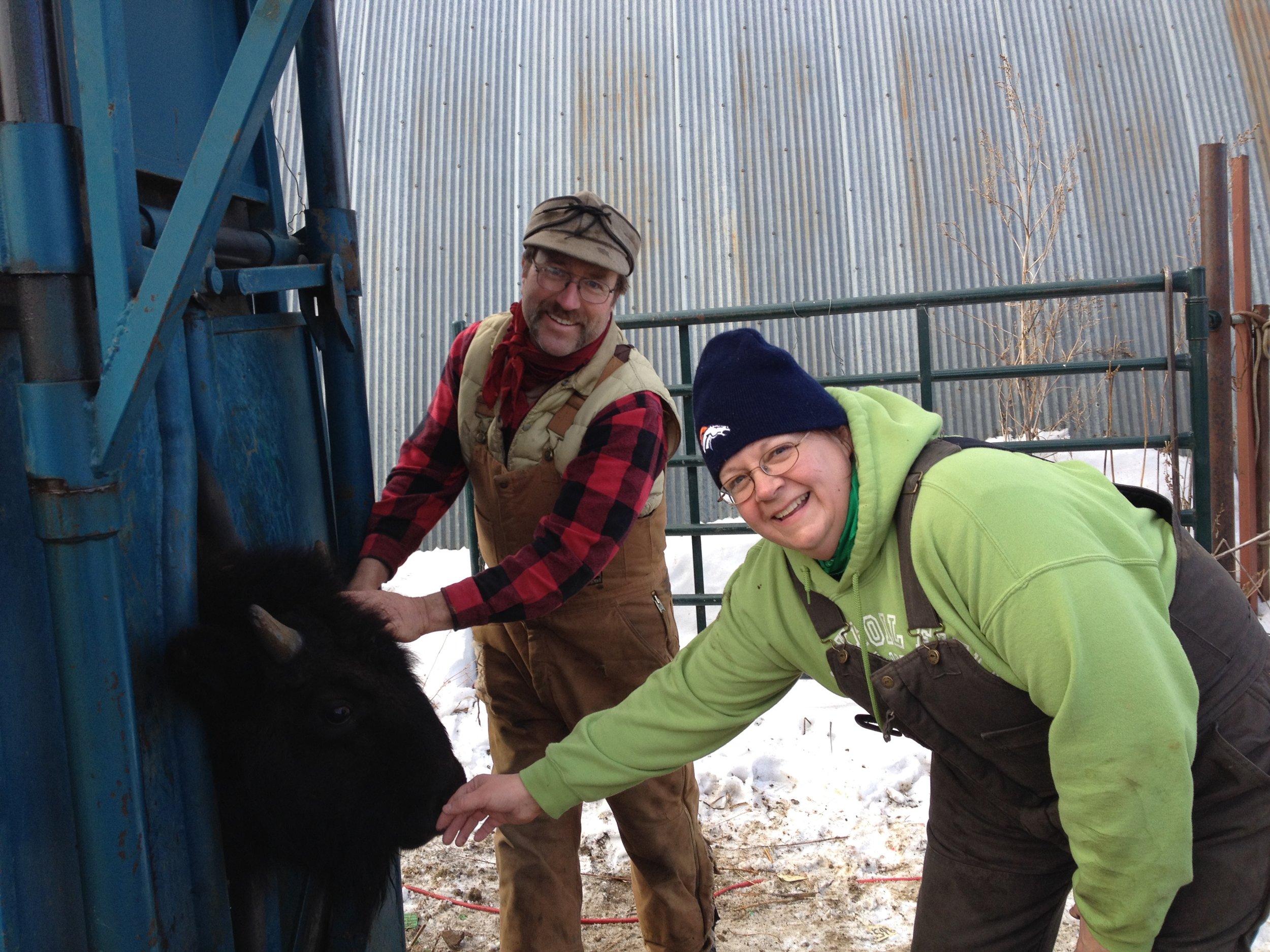
Buffalo ranchers Steve and Roxann McFarland work buffalo in the chutes on a cold January morning on their ranch southwest of Hettinger. Photo by Francie Berg.
7. Oh, and we’re not forgetting Grandmas and Grandpas! Looking for a bit of fun and new experiences when you open your computer? Maybe you live alone and it gets lonesome at times, doesn’t it? Need a friend? We promise you’ll meet herds of four-legged friends right here. But a word of caution, don’t expect the cuddly kind of friends! What we’ll bring you are sound and solid, four-feet-on-the-ground, no nonsense, but near-wild animals, who will gain your respect, and I think, in time, your affection.
And some fun stories too!
Enjoy the journey!
Want to Raise your own Buffalo Herd?
Wouldn’t that be fun!! Your own buffalo herd!
My Veterinarian husband—a practical man who soon gained buffalo experience—nixed that idea every time I brought it up.
But there are many hobby buffalo farmers around. If you yearn to have your own buffalo, say, a bull and 2 cows—well, many buffalo ranchers, big and small, started in just that way.
“Buffalo are like rabbits! If you’re not careful, pretty soon you’ve got too many!” A Wyoming rancher warned her friends after watching their herd grow from 1 bull and 2 heifers to 500 animals—outgrowing their pastures. SD Tourism.
They called it a “hobby herd.”
It’s not an entirely bad idea.
Just watch a group of Native American boys and girls visiting their own tribal herd. Note the pride and awe in their eyes, their silence and whispering voices, and you’ll have an idea of the respect these animals command, just by being themselves.
But watch out! Be warned of two things: they multiply and they’re not as gentle as they look.
“Buffalo are like rabbits! If you’re not careful, pretty soon you’ve got too many.” That’s what Toots Marquis, a woman rancher from Gillette, Wyoming, warned her friends.
The grandfather in her family bought a buffalo bull and two heifers, just for the novelty of it, to run with his cattle.

A group of Native American boys and girls from the Oneida Tribe in Wisconsin get a rare close-up view of their tribal herd on a field trip. Courtesy of Oneida Tribe.
In what seemed like only a few years, they multiplied to 500 animals. By the time Marquis was left in charge by herself, she struggled to cull them back and keep the herd at around 75.
And don’t imagine that buffalo are going to be nice and cuddly.
Even playful calves bucking through a herd—don’t think you’ll join them. There’s more than one hostile mother watching, possibly all set to charge.
Don’t even think of posing for a selfie by edging close to a lethargic-looking bull. Remember the warnings, you’ll need something large—like maybe a pickup truck—between you and that big guy, just standing there watching you with what, deceptively, looks like sleepy eyes.
Their sleepy demeanor has fooled many. That bull can spin on a dime and run 40 miles an hour!
Can you? If not, then look out!
One day in 1906, a group of Mexican dignitaries came up the Missouri River in a tour boat to see Scotty Phillip’s buffalo herd in the badlands. They laughed at the big bulls, and boasted—with a bit too much exuberance—that their feisty Mexican fighting bulls would make short work of those lazy, slow moving bulls.
They challenged a bull fight—but that’s another story. We’ll tell you about the Mexican bull fight in Juarez another time (or you can read about it in Buffalo Heartbeats on page 182).
Then there are the fences. Are yours high enough? Strong enough?
You don’t have to own buffalo to enjoy them, of course. You can see them in many state and National Parks in the US and Canada.
In fact, I’m pretty sure everyone who has a passion for them might need to contemplate a live buffalo herd occasionally for a good measure of that peace and tranquility.

People tell me the more you get to know buffalo, the more you will love them. SD Game, Fish, Parks, photo by Chris Hull.
Don’t worry. Most of us can find buffalo around—in public zoos and parks, or private herds that you might view from the road, or nearby tribal herds which you can arrange to visit.
You might be surprised at the bison opportunities near where you live right now. If not, please come to see us on the Northern Plains, or contact your nearest Indian Reservation. They enjoy showing their buffalo herd to visitors.

Happy National Bison Day!!
OctobeI 25, 2023
t’s coming up! Buffalo Day is November 4, 2023—Always the first Saturday in November. Get your family ready to celebrate! Remember, in the US and Canada we use the terms Bison and Buffalo interchangeably. And that’s OK. Either fits!
by Francie M. Berg
It’s coming up! Buffalo Day is November 4, 2023—Always the first Saturday in November. Get your family ready to celebrate!
Remember, in the US and Canada we use the terms Bison and Buffalo interchangeably. And that’s OK. Either fits!!
Some would have us use only the scientific name, Bison. But just think how many cities and towns, counties, creeks, rivers and majestic buttes across this North American continent are named for Buffalo! Would the so-called “experts” have us change them all? Impossible, of course. And how petty to be so limited in our vision!
We’ve been using that term since 1616 when the French explorer, Samuel de Champlain, used it to describe the animal. A few years later, in 1625, Buffalo first appeared in the English language in North America, from the French word, boeuf, a Greek word given to Buffalo by French fur trappers here. Not until 1774—a century and a half later—was Bison first recorded to refer to these mammals in a scientific sense. So are we OK with that?
“We want to go full Buffalo and embrace their unique appearance, calming personalities and utterly cute shapes. Get ready to learn more about them and why we should all try and be more like bison,” says one Buffalo Aficionado.
Anyway,—no apologies. Use whichever you prefer. (Except of course in a scientific discussion.)
How will You Celebrate?
1. Wear a Buffalo T-shirt
Select a T-shirt that shows your love of bison—and wear it proudly! Your kids will enjoy a new Buffalo shirt if they don’t have one! So will Grandpa and Grandma.

South Dakota Game, Fish & Parks, Chris Hull, photographer
2. On National Bison Day—Change your profile picture to Bison
On National Bison Day—November 4, 2023—Change your profile photo on social media to a Buffalo silhouette. It’s an annual event that falls on the first Saturday in November. All Americans can reflect on the impact bison have as a part of our environmental and cultural heritage.
Keep it up for a full month! November is Native American month--you can honor Native Americans at the same time with a nice Buffalo photo. Buffalo are especially revered by Native people—They’ve been central to their survival for centuries as both food and spiritual inspiration.
3. Visit a Buffalo herd
A vast number of wildlife parks, tribal herds and buffalo ranches showcase Buffalo across the US and Canada. Find out if any are located close to where you live. Your children will be delighted to experience the wonder of our latest national icon—the Bison, or Buffalo!
However, take care! Don’t get too close—75 feet or more is recommended! Buffalo are stoic—but don’t try to push them around!
4. Plan a Party
Celebrate with a family party, kids party, young adult party or just friends getting together.
Buffalo are easy to draw. Design and paint or color a stand-up place card for each guest. Or design some dark brown bushy beards. Tie them on your guests with a shoestring around the ears. Know any Buffalo games?
5. Eat some Bison—yum, yum! Tastes great!

National Bison Association
Delicious! Buffalo Producers celebrate National Bison Month in July as a great time to grill bison meat. Select any tender cut from Prime rib steak to hamburger! You might be amazed that it’s healthy as well as tasting great!
Producers want you to know that bison is the leanest protein available to consumers today, boasting 26% more iron than beef and 87% lower in fat. Bison has 766% more B12 vitamins than chicken, and 32% less fat, based on nutrient data from the U.S. Department of Agriculture.
6. Watch a Buffalo video
There are several good possibilities, both short and long videos, on the National Park Service (nps.gov), Public TV, and Wildlife Parks websites. Or you might decide to review some of our Blogs. We’ll have more suggestions for you after our Website goes live in November!
Fun Facts About Bison
1. Buffalo Survive just fine through long, cold Winters
Their hump is composed of muscle supported by long vertebrae, which allows them to use their heads to plow through deep snow and eat grasses below. They also thrive on cottonwood leaves and browse.

National Park Service, Yellowstone Park at Nez Perce, 1966. Mary Meagher, photographer
Fierce blizzards don’t faze them. Buffalo face into a storm rather than walking away from it. Or they lie down, letting it blow over. Thus they avoid being trapped by fences, water holes and creeks as happens to cattle and sheep—which travel with the wind.
2. Calves are born a Different Color than their Moms
Buffalo calves are called ‘red dogs’ by Forest Rangers. When born they are orange or cinnamon colored. It takes 3 to 4 months to grow a hump and spike horns, shed their baby hair and change to a darker color like their mothers. Their heads turn blackish first.
3. Buffalo can outrun most Mammals
Buffalo bulls may look big, slow and lazy. But don’t be fooled! They can spin on a dime, jump straight up and over a 5- or 6-foot fence, leap a 7-foot long jump, run up to 35 miles per hour and are strong swimmers.
In addition, it seems, a Buffalo bull on the fight can tear down most any fence that is in his way! So be sure to place something large—like a pickup truck—between you and that bull!
4. Moms are fiercely Protective of their Young Calves

National Park Service’s BisonBellows-Elk Island
Mothers stay close by their buffalo calves and fight off predators. However, if she has twins, a mother might select only one, walking away from the other. Does she perhaps realize she can care for only one lively calf? Or maybe she instinctively knows she won’t have enough milk to raise two healthy calves?
5. Dads and Uncles still Guard the Herd when they feel Threatened
When predators threaten, Buffalo bulls may circle the group into a tight herd, facing out and pawing dirt, with mothers and calves protected inside the circle.
6. Who really Saved the Buffalo from Extinction?
Those who really saved the Buffalo were ordinary people—westerners, ranchers, all buffalo hunters, with boots—or moccasins—on the ground. Separately, these families cared for and brought buffalo back in significant numbers for survival—onto the western plains and grasslands.
Without them American bison would likely have gone extinct! These 5 family groups saved calves one at a time. All had hunted buffalo, both Native American and white. They saw what was happening to the buffalo and cared about saving them.
Samuel Walking Coyote (or his son-in-law), and herd purchasers Charles Allard and Michel Pablo in western Montana
James McKay and neighbors in Manitoba, Canada
Pete Dupree and herd purchasers, the Scotty Philips in South Dakota
Charles and Molly Goodnight of Texas
Buffalo Jones of Kansas
At crisis time—in the 1880s and 1890s—these families were the only ones standing between live buffalo and determined hide and trophy hunters who poached even the few remaining Yellowstone Park herds down to fewer than 25!
7. A President helped Save the Buffalo
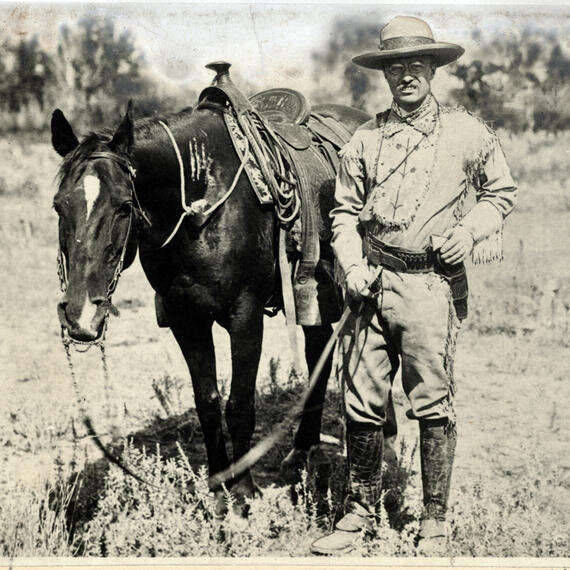
The Buffalo Conservationists we know best are President Theodore Roosevelt, William Hornaday and George Bird Grinnell. Together they made a significant impact on wildlife conservation—particularly on buffalo.
Teddy Roosevelt, a frail child, built up his strength and endurance and helped restore buffalo after he traveled to Dakota Territory to hunt them in 1883. He shot an old bull and stayed to set up a cattle ranching enterprise. On his western ranch Roosevelt soon realized that the elk, bighorn sheep and buffalo that he so admired would not survive relentless overhunting. He grew increasingly convinced of the need to protect the buffalo and provide large, safe places for them and other wildlife to live.
As president—from 1901 to 1909—he became one of the most powerful voices in the history of American conservation and earned himself a place on Mt. Rushmore, SD, as this country’s greatest champion of public lands. Roosevelt created the United States Forest Service and established 150 national forests, 51 federal bird reserves, 4 national game preserves and set aside 230 million acres of public land. He worked with Congress to establish 5 national parks and dedicated 18 national monuments.
8. Native Americans are Interrelated culturally with Bison

The history of Native Americans and bison is culturally interrelated. Bison have been integral to tribal culture, providing Native people with food, clothing, fuel, tools, shelter and spiritual value from time immemorial.
Established in 1992, the InterTribal Buffalo Council works with the National Park Service to transfer excess Buffalo from national parks to tribal lands. It also gives assistance in management of herds and how to integrate traditional values to the experience.
9. Bison have poor Eyesight
Buffalo cannot focus well and are known to have poor eyesight. But with one eye on each side of their heads they are said to have good peripheral vision, able to keep track of 90% of the area that surrounds them. Handy for checking on lurking wolves!
Buffalo do have excellent senses of smell and hearing and communicate well with their herd. Cows and calves communicate using pig-like grunts and during mating season, bulls can be heard bellowing across long distances.
10. Bison have been around for Ages

National Park Service, photographer J Schmidt1977
These giants have such a special place in the country's history and ative American cultures and for good reason. They are fiercely protective yet calm animals that will do anything to protect their herds and their calves. They are truly North American treasures!
11. Buffalo are Social Creatures

National Park Service, North Rim of the Grand Canyon
They like living together in herds. But not just any group—their own herd. And not too large a herd—30 to 60 seems a good size. For most of the year, the buffalo sort themselves into “cow groups,” or maternal herds, and “bull groups.”
An older grandmother is the usual leader of the herd. She leads them to water at the time that seems right to her. Bull calves are allowed to stay in the herd with their mothers until they become too large and aggressive. Then they are kicked out of the maternal herd to join bachelor groups that wander at a short distance from the main herd.
In the wild herds of long ago, with roughly equal numbers of males and females, bachelor herds were known to be large.
Historically in late July and August, the great herds came together for rut, or breeding season. Today in managed herds, young bulls are usually sold off long before age three. They sell well in the market place for meat or as potential herd bulls. In Native tribal herds young bulls are especially desirable to provide meat for naming feasts and community gatherings. By giving of their meat, they honor the person celebrated, especially when the honored one is a young man.
This prevents buffalo herds from out-growing their pastures. Otherwise, the herd will double and redouble in a few years, soon over-grazing their pastures. Having fewer bulls also means less fighting, and makes breeding easier for the dominant bulls. The oldest bulls often range far from their home herd.
12. Buffalo Enjoy a Wallow

National Park Service
A little dust or mud won’t hurt. Called wallowing, bison roll in the dirt to get rid of biting insects and help shed their winter coat. Male bison also wallow during mating season to leave behind their scent and display dominance.
13. Watch Buffalo’s Tail for Warning
You can judge a Buffalo’s mood by its tail. When it hangs down and switches naturally, the buffalo is usually calm. If the tail is standing straight up, watch out! It may be ready to charge. No matter what a bison’s tail is doing, remember that they are unpredictable and can charge at any moment. Every year, there are regrettable accidents caused by people getting too close to these massive animals. It’s great to love the bison, but love them from the distance of at least 75 feet.
14. Buffalo eat Grass, Weeds, Browse
Pass the salad, please. Bison primarily eat grasses, weeds and leafy plants—typically foraging for 9-11 hours a day. That’s where the bison’s large protruding shoulder hump comes in handy during the winter. It allows them to swing their heads from side-to-side to clear snow -- especially for creating foraging patches. Learn how bison's feeding habits can help ensure diversity of prairie plant species after a fire.
15. Average Lifespan 10 to 20 Years
Bison can live up to 20 years old, but some live to be much older, especially with good care on ranches.
A buffalo cow may weigh 1,000 pounds, while the bull weighs twice as much, or up to 2,000 pounds! Cows begin breeding at the age of 2. For males, the prime breeding age is 6 to 10 years.
16. Improving Soil
Bison are known to play an important role in improving soil and creating beneficial habitat while holding significant economic value for private producers and rural communities.
17. Ancient Bison came from Asia
The American bison’s ancestors can be traced to southern Asia thousands of years ago. Bison made their way to America by crossing the ancient land bridge that connected Asia with North America during the Pliocene Epoch, some 400,000 years ago. These ancient animals were much larger than the iconic bison we know and love today.