
Four Iktomi Stories
This video is part of a set of interviews for the WoLakota Project. www.wolakotaproject.org “WoLakota” implies balance and coming together. The WoLakota project supports students in high-need schools, pairing trained mentor-teachers with new teachers and providing Courage to Teach circles to tend to the ʻheartsʼ of each.
October 3, 2026
This video is part of a set of interviews for the WoLakota Project. www.wolakotaproject.org “WoLakota” implies balance and coming together. The WoLakota project supports students in high-need schools, pairing trained mentor-teachers with new teachers and providing Courage to Teach circles to tend to the ʻheartsʼ of each. Mentors support the embedding of the Oceti Sakowin Essential Understandings (OSEU) into practice, complementing the Common Core. The OSEU address the achievement gap of American Indian students by embracing their identity, and promote cultural understanding among non-native students and teachers. Lakota Elder Dottie LeBeau states, “When we approach teaching with one worldview…we create systems of failure in our schools.” WoLakota closes the circle into a system of understanding and success. The WoLakota Project is a partnership between TIE and the SD Department of Education
Mr. Hollow Horn Bear is a member of our advisory counsel, one of the original Elder-authors of the Oceti Sakowin Essential Understandings. Duane is also a wonderful storyteller. We are so happy to be able to share some of the stories he has shared in both English and Lakota language formats.
History for the Mandan, Hidatsa and Arikara
History for the Mandan, Hidatsa and Arikara
Reprinted from https://www.mhanation.com/history
Relocation from the bottomlands
Within a few years the Three Tribe's members were obliged to move to new homes. Relocation and salvage procedures established by the Corps proved unsatisfactory. Private movers contracted by the army were unreliable, and tribal members were denied permission to cut most of their timber prior to inundation.
September 5, 20206
Reprinted from https://www.mhanation.com/history
Relocation from the bottomlands
Within a few years the Three Tribe's members were obliged to move to new homes. Relocation and salvage procedures established by the Corps proved unsatisfactory. Private movers contracted by the army were unreliable, and tribal members were denied permission to cut most of their timber prior to inundation. Flooding of the bottom lands rendered the residual reservation useless. Settlement payments were too low to provide full reestablishment of most families. The uprooting of kinship and other primary groups destroyed the community life so fundamental to the Indians' culture. Farms and ranches were liquidated, unemployment rose as high as 70 percent, and many tribal members were driven to a life of despair in nearby urban centers.
Millions of dollars in federal funds were pumped into the reservation to counteract social and economic damages. After a generation of hard work the tribes began to show signs of recovery, but psychic scars from the ordeal remained evident today. (Lawson, p.61-62). The tribal members' concern was to find sites for wells in the area to which most of them were going to move. In April, 1950 actual test drilling began. By September 27, wells had been drilled in the Western Segment, and possible home sites were being selected.
Present Day
The Fort Berthold Agency, formerly situated at Elbowoods until 1953 when it was flooded by the Garrison Dam, is now located in New Town. The reservation lies on both sides of the Missouri, including parts of Dunn, McKenzie, McLean, and Mountrail counties. The seat of tribal government for the Mandan, Hidatsa and Arikara Nation lies four miles west of New Town.
The Four Bears Area includes the tribal administration building, Indian Health Services Clinic and Dialysis Unit, Casey Family Program, Ft. Berthold Day Care, KMHA Radio Station, MHA Times (tribal newspaper), and the Three Affiliated Tribes Museum. This complex is directly adjacent to the tribe's Four Bears Casino, Lodge, and Recreational Park.
Today, the Three Affiliated Tribes, as a governmental entity, administers many governmental, economic, health, welfare, and educational programs. Located in the Four Bears Complex area, the tribal administration operates in a modern complex of business offices. Revenues are generated primarily from various Government enterprises, programs and grants. From this location, The Mandan, Hidatsa, and Arikara Nation, the Three Affiliated Tribes, carry out their sovereign responsibility of governance of the reservation and its people. Although federal government policy and various Supreme Court decisions from the early 1960's to the mid-1980's reflected a period of acknowledgment and support tribal sovereignty , as tribal nations practice and assert their sovereign rights, the mood of Congress and the courts have forced the pendulum to move in a direction that seeks to limit the powers of tribal nations.
Reprinted from https://www.mhanation.com/history
History for the Mandan, Hidatsa and Arikara
History for the Mandan, Hidatsa and Arikara
Reprinted from https://www.mhanation.com/history
Laws and treaties Atkinson & O'Fallon trade and intercource Treaty of 1825
The first major treaties made with tribes in this region were made in 1825. A group under Indian Agent Benjamin O'Fallon and General Henry Atkinson traveled up the Missouri to the Yellowstone with nine keelboats and a large military escort, making treaties with the Teton, Yankton, and Yanktonai Dakota, Cheyenne, Mandan, Hidatsa, and Arikara.
Reprinted from https://www.mhanation.com/history
Laws and treaties Atkinson & O'Fallon trade and intercource Treaty of 1825
The first major treaties made with tribes in this region were made in 1825. A group under Indian Agent Benjamin O'Fallon and General Henry Atkinson traveled up the Missouri to the Yellowstone with nine keelboats and a large military escort, making treaties with the Teton, Yankton, and Yanktonai Dakota, Cheyenne, Mandan, Hidatsa, and Arikara. In these treaties the Indians acknowledged the supremacy of the United States, which in turn promised them its protection. The Indians agreed not to trade with anyone but authorized American citizens. They also agreed to the use of United States law to handle injury of American citizens by Indians and vice versa. On July 18, 1825. The Ankara signed the Atkinson and O'Fallon Treaty. (Schulenberg, 1956, p.101).
THE 1851 TREATY AT FORT LARAMIE
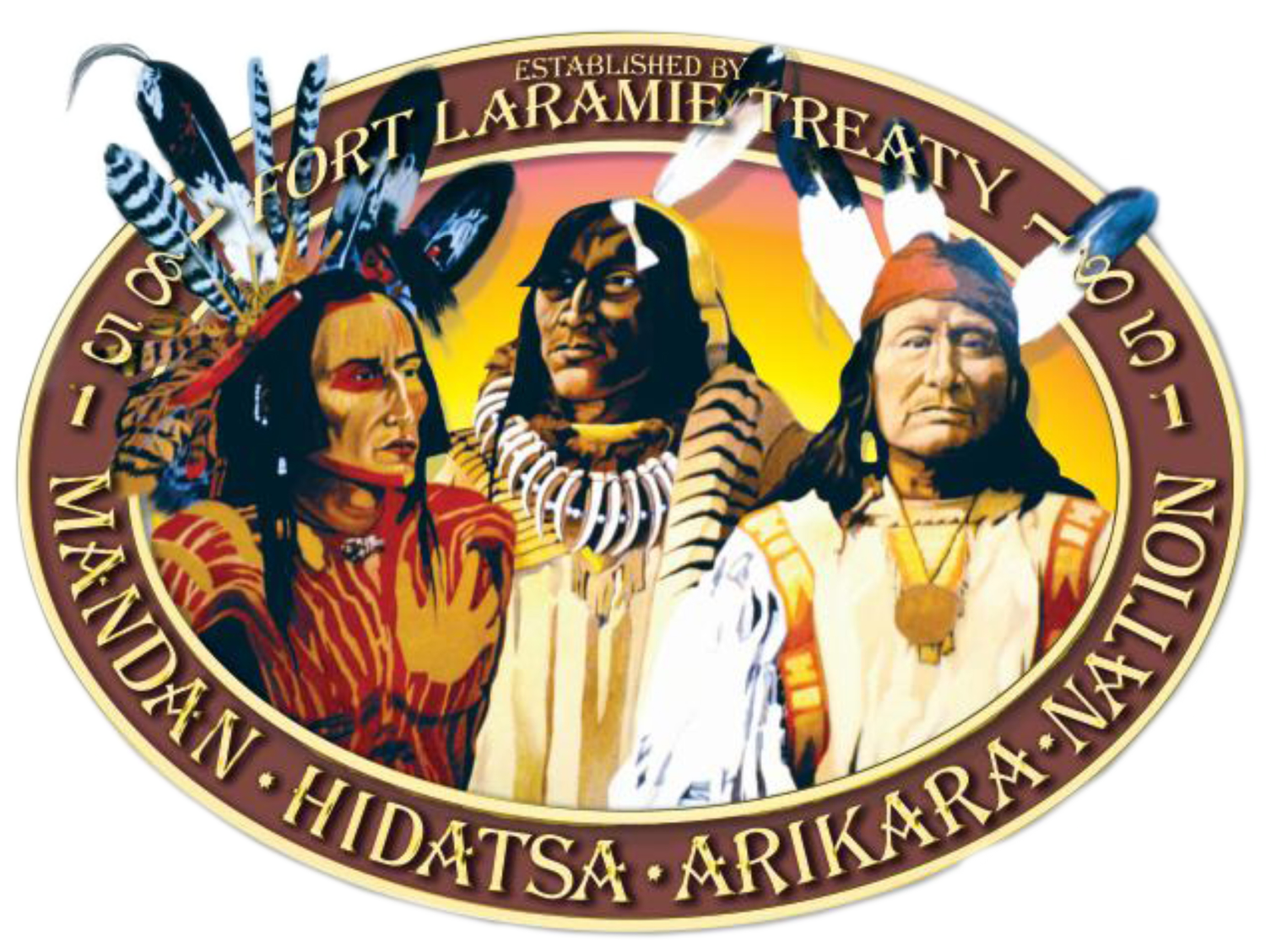
In 1851, a tribal delegation of Mandan, Hidatsa, and Sahnish accompanied Father Pierre-Jean DeSmet to Fort Laramie to hold council with representatives of the government of the United States. White Wolf represented the Mandan, Four Bears represented the Hidatsa, and Iron Bear the Sahnish. Colonel M. Mitchell and Major Fitzpatrick represented the government. The boundaries of the Mandan, Hidatsa, and Sahnish territory were set-aside in the 1851 Fort Laramie Treaty: Commencing at the mouth of the Heart River; thence up the Missouri to the mouth of the Yellowstone River; thence up the Yellowstone to the mouth of Powder River, thence in a southeasterly direction to the headwaters of the Little Missouri River, thence along the Black Hills to the headwaters of the Heart River; thence down the Heart River to the place of the beginning. (11 Stats., p.749, in Kappler, 1972, p. 594, Article 5).
This was the largest treaty council ever held. More than ten thousand plains Indians from the Lakota, Cheyenne, Arapaho, Crow, Mandan, Sahnish, Assiniboine, and Gros Ventres (Hidatsa) nations attended. In exchange for fifty thousand dollars a year for fifty years, the nations agreed to allow the United States to construct roads and military posts through their country. The tribes also established the boundaries of their territories and agreed to maintain peaceful relations with one another and with the United States. Several tribes, including the Mandan, Gros Ventres (Hidatsa), Crows, Blackfeet, and some bands of the Cheyenne and Arapahos, accepted reservations. (O'Brian, 1989, p.141).
Following the Fort Laramie Treaty of 1851, the government established several forts along the Missouri. In 1864 the cavalry was sent to Fort Berthold and remained there until 1867 when they moved to Fort Stevenson, 18 miles down river. The establishment of forts brought numerous groups up river by steamboat-twenty to thirty steamboats stopped at Like-a-Fishhook Village every summer. By 1869, the railroad had reached the territory of the Mandan, Hidatsa and Sahnish, a bustling economic center for the region. By 1871, federal Indian policy shifted radically for several reasons. An act of Congress in 1871, "Provided that no treaties shall hereafter be negotiated with any Indian tribe within U.S. as an independent nation or people. "Thereafter all Indian land cessions were achieved by act of Congress or by executive order. Indian societies were being transformed radically from a combination of forces -U. S. Army troops stationed at posts near Fort Berthold after 1864, Indian agency personnel resided on the reservation after 1868, and day schools were opening on reservations as early as 1870.
AGREEMENT AT FORT BERTHOLD 1866
As more settlers poured into the west, the government, pressured by the railroads and settlers for more land approached the tribes to cede additional lands. On July 27,1866, the Arickara (Sahnish) signed an agreement by which they granted such rights-of-way to territories east of the Missouri, and were to receive in return an annuity of $10,000 for the next twenty years. When the treaty was presented for ratification, Congress added an addendum onto this agreement, including the Mandan and Hidatsa in its terms and provided for cession of a tract of land on the east bank of the Missouri roughly forty by twenty-five miles. (Kappler, 1904-41, report. ed. 1971, Vol. 2, pp. 1052- 56).
These lands, which were well below the villages of where the Mandan, Hidatsa and Arikara were in 1866, although no longer continuously occupied by them, continued to be used for hunting purposes. In addition, these lands contained ancient burial sites, and like many cultures considered the area as sacred ground. Congress, however, pressured by the railroad companies, was unwilling to recognize the tribes claim to these lands and the treaty was never ratified. (Meyer, 1977, p. 111).
EXECUTIVE ORDER OF 1870
The Fort Berthold Reservation was established under the Executive Order of 1870. In the late 1860's the Mandan, Hidatsa and Arikara (Sahnish) complained of their wood supply dwindling by whites cutting timber on their lands and selling it to passing steamboats. When the chiefs complained to Washington, a Captain Wainwright, officer at Ft. Stevenson, met with the chiefs. They consented to the establishment of a reservation that included most, if not all of the territory claimed by them at Fort Laramie. (Meyer, p. 112).
Because the Sioux had claimed possession of a parcel of the land in question the previous year, the Government took off the southern boundary of the Mandan, Hidatsa and Sahnish territories. The southern boundary of the reservation became a straight line from the junction of the Powder River from the Little Powder River to a point on the Missouri River four miles below Fort Berthold. In order to accommodate the villages then occupied by the Mandan, Hidatsa and Sahnish, the United States Government included a strip of land east of the Missouri River. These provisions became legal in the Executive Order of Apri1 12, l870. (See map on p. 14).
History for the Mandan, Hidatsa and Arikara
History for the Mandan, Hidatsa and Arikara
Reprinted from https://www.mhanation.com/history
Garrison Diversion Unit Commission
In the early 1980s, the Three Affiliated Tribes initiated a move for “just compensation" for lands that were lost to construction of the Garrison Dam. A committee was established to gather testimony and evidence in hearings held on the Standing Rock and Fort Berthold Reservations, as well as other sites. The Final Report of the Garrison Diversion Unit Commission pointed out that the Tribes of the Standing Rock and Fort Berthold Indian Reservations shouldered an inordinate share of the cost of implementing the Pick-Sloan Missouri Basin Programs" mainstream reservoirs. (Final GDUC Report, Appendix F., p. 57).
Reprinted from https://www.mhanation.com/history
Garrison Diversion Unit Commission
In the early 1980s, the Three Affiliated Tribes initiated a move for “just compensation" for lands that were lost to construction of the Garrison Dam. A committee was established to gather testimony and evidence in hearings held on the Standing Rock and Fort Berthold Reservations, as well as other sites. The Final Report of the Garrison Diversion Unit Commission pointed out that the Tribes of the Standing Rock and Fort Berthold Indian Reservations shouldered an inordinate share of the cost of implementing the Pick-Sloan Missouri Basin Programs" mainstream reservoirs. (Final GDUC Report, Appendix F., p. 57).
This report highlighted the inequities borne by the tribes: The tribes were not only unwilling to sell their land, but strongly opposed the taking of their land. They felt intimidated by the fact that construction on the dams began before Indian lands were acquired. They then felt that the taking of their lands was inevitable. During the negotiation phases, assurances were given expressly or by implication by various Federal officials that problems anticipated by the Indians would be remedied. The assurances raised expectations which, in many cases, were never fulfilled. The quality of replacement homes was inadequate in many respects, but most notably with regard to insulation and construction necessary to meet severe climatic conditions.
The deficiencies, in many cases, resulted in inordinately high heating bills. Indian lands taken were "prime river bottomland" and the most productive parts of the reservation. The quality of life enjoyed by the tribes on the river bottomlands had not been replicated in the removal areas The rise in the incidence of trauma and stress-related maladies and illnesses following removal suggested a causal relationship. They were not justly compensated by the United States for the taking of their lands and related expenses resulting from the land taken. United States land acquisition practice resulted in the taking of a substantially larger area of Indian land.
Joint Tribal Advisory Committee (JTAC)
On May 10,1985, the Garrison Unit Joint Tribal Advisory Committee (JTAC) was established by the Secretary of the Interior. This committees' role was threefold:
A) to examine and make recommendations with respect to the effects of the impoundment of waters under the Pick-Sloan Missouri Basin Program (Oahe and Garrison Reservoirs)
B) to study their impact on the Fort Berthold and Standing Rock Reservations
C) to replace what was destroyed by the creation of the two dams. The committee was authorized and directed to examine and make recommendations to the following issues:
Full potential for irrigation
Financial assistance for on-farm development costs
Development of shoreline recreation potential
Return of excess lands
Protection of reserved water rights
Funding of all items from the Garrison Diversion Unit funds, if authorized
Replacement of infrastructures lost by the creation of the Garrison Dam, Lake Sakakawea, the Oahe Dam and Lake Oahe
Preferential rights to Pick-Sloan Missouri River Basin Power
Additional financial compensation, and Other items the committee deemed important (JTAC -Executive Summary, 1985)
The substance of the JTAC Report provided the initiative for the Three Tribes to seek legislation for additional economic and financial recovery funds. The tribe's efforts continued until 1992, with the assistance of the state's Congressional delegation. As a result, Congress, in 1992, passed Public Law 102-575 providing $142.9 million in economic recovery funds to the Three Affiliated Tribes. The fund, known as the Economic Recovery Fund, was to be used for education, economic development social welfare and other needs. Only the interest could be expended. After the Garrison Dam settlement funds were distributed, there was a steady economic decline until about 1961. The three affiliated tribes faced the reality that their settlement funds were gone, the economic base of the reservation was not producing enough wealth to enable them to recoup their losses, the plans for educational and health services were not working, and their relations with federal, state, and local governments were aggravating their problems. The thirty-first legislative assembly authorized the creation of the North Dakota Indian Affairs Commission in 1949, along with an appropriation of $20,000 and a membership of thirteen.
The first biennial report stated, the Commission believes that the Indians in the state of North Dakota are now and should remain, the responsibility of the Federal Government until such time as the individual Indian and his family have become assimilated into the social and economic structure of the community in which he lives. The Commission was instrumental in the formation of the Fort Berthold Inter-agency Committee on October 19, 1951. This group held at least six meetings in the following fourteen months, at Stanley, Garrison, Elbowoods, Killdeer, and elsewhere, on such topics as health, education, roads, welfare, law and order, and legislation. The subject concerning the precise boundaries between state and federal jurisdiction (not to mention tribal) were obscure and in a state of flux. (Meyer, p.239).
Two changes in federal Indian policy in 1953 precipitated state action. The old ban on the sale of liquor to Indians was lifted that year by act of Congress, but North Dakota still had a law of its own on the books. After it was repealed in 1955, the tribal council voted to permit liquor on the reservation. The responsibility of law and order on the reservation was operated on their own codes of law and order, locally administered by tribal courts and police. North Dakota Indians were protected by a provision in the state constitution, but in 1955 the legislature voted to place on the primary ballot for the next year a proposed amendment that would permit the state to assume responsibility for law and order on Indian reservations. Defeated that year because it might increase the tax burden, the amendment reappeared in 1958 and was passed. Because of serious financial problems of the Tribes in 1959, a committee recommended that the state assume civil jurisdiction over the reservation. No action was taken. The Bureau began changing its policies during this time so as to place greater emphasis on decision making by the Tribes and on development of reservation resources. This did not become reality until the Indian Self-Determination Act was passed in the mid 1960's.
The growing economic crisis in the later 1950s and aggravated by drought became a more serious problem than that of termination. Efforts to meet the crisis took three forms: attempts to retain and utilize the remaining reservation resources, mainly land, attempts to obtain credit through loan programs, and attempts to attract industry to the reservation and the surrounding areas. Not much success was achieved in any of these directions up to 1962. The use of reservation land was complicated by the fact that the Indians were continuing to lose their lands. The Indian Reorganization Act had tried to stop of issuance of fee patents. Despite protests from the council, patents were issued and the land in many cases was promptly sold. By the end of 1959 the reservation had dwindled to 426,413 acres, of which only 21,308 was tribally owned. Sixty percent of the reservation land was being used by non-Indians and of 184 potential agricultural units, only 40 percent were being used by Indians. (Meyer p. 241).
A more important mineral resource was oil. Only a few individuals benefited from oil leases, and most of these benefits were negligible and temporary. This oil boom did not seem to have any effect on the general economic condition of the reservation. Three pieces of legislation passed by the Eighty-seventh Congress had important long range effects on Fort Berthold: the Area Redevelopment Act of May 1, 1961, the Manpower Development and Training Act of March 15, 1962.
The first of these proposed to establish a program to alleviate conditions of substantial and persistent unemployment and underemployment in certain economically distressed areas and specifically mentioned Indian reservations as eligible for assistance. Retraining schools were established and started in the summer of 1962 in arts and crafts, farm training, and stenographic and clerical work. The Manpower Development and Training Act provided funds for a construction carpentry program to begin with at least twelve persons. When a housing program got under way, men trained in these classes did much of the work. Under the terms of the Public Works Acceleration Act, $50,000 was provided for timber stand improvement, forest access and fire protection roads, and forest visitor use facilities. (Meyer, p. 245).
Construction projects, such as the new high schools being built at White Shield, Mandaree, and Parshall, provided only temporary employment for the people, who were looking for permanent jobs. Efforts were stepped up to attract industry to the reservation. One such endeavor was from the Precision Time Corporation to build a watch company to employ 200, but this ran into snags and fell through. Another attempt made by the Venride Corporation, a manufacturer of coin-operated kiddy rides, employed only six people for several months. Predictions of better things to come never happened. It was forced to shut down in October 1965. Intermittent employment was also provided by the construction of recreational facilities and a museum at Four Bears Park. Besides assisting in providing employment, mainly through public works projects, the federal government invested heavily in programs of greater long -range importance to the Fort Berthold people.
Early in 1965 the Office of Economic Opportunity began making available funds for such purposes as a kindergarten, a remedial education program, a family counseling service, a livestock operator's training course, and credit union assistance. Of all the federally supported programs designed to aid the people was a massive housing project for the reservation and the neighboring towns of New Town and Parshall inaugurated in 1963, the plan proposed two types of housing: low-rent units and "mutual self-help" housing. (Meyer, p.246).
Another permanent employer was the development of Four Bears Park into a major recreation center. In 1968 the Economic Development Administration approved a tribal application for grant-and-loan financing of a project, estimated to cost about $1,200,000, calling for a forty-unit motel, a seventy-eight place cafe, a meeting room, a lounge, a twenty- four unit trailer pad, a marina building, and a service station. This project was completed in June of 1972 and employed twenty-three members of the Tribes. (Meyer, p. 251).
A pottery-making enterprise started in 1966 employed only four tribal members. Northrop Dakota, a manufacturer of electronic assemblies for aircraft, including the Boeing 747, began their operations in October 1970, employing thirty people, of whom twenty were Indians. The number increased to forty-five by mid-1973. Another industrial development from Consolidation Coal Company of Pittsburgh to exploit part of the estimated fifteen billion tons of lignite reserves at Fort Berthold didn't materialize because the Coal Company didn't file an environmental impact statement Public Law 91-229 passed in 1970, enabled the Tribes to receive a $300,000 Farmers Home Administration loan to buy up fractionated holdings and consolidate them into more efficient units. As a result of this, the amount of tribal land has been increasing. The reservation community is changing rapidly, and much of the change is in the direction of acculturation to the larger American society. As observers recognized at the time the Garrison Dam trauma was occurring, the resultant social dislocation accelerated a process already under way but strongly resisted. Shortly before that disruptive experience began, Edward M. Bruner studied the Fort Berthold society intensively and offered some considered judgments. Conceding that the observer's biases had much to do with what he saw, Bruner concluded that "the assimilation which goes on within the communities is extremely slow, tends to be relatively superficial, and does not seem to change the prevailing Indian value system. "The picture he got was one of "a native core surrounded by peripheral white borrowings."
A contemporary judgment, perhaps even more subjective, would see a basically mixed culture, with the non-Indian elements dominant but Indian elements tenaciously and consciously preserved by a people, as adaptable as their ancestors, determined to have the best of both worlds. (Meyers, p. 265)
Reprinted from https://www.mhanation.com/history
History for the Mandan, Hidatsa and Arikara
History for the Mandan, Hidatsa and Arikara
Reprinted from https://www.mhanation.com/history
Fort Berthold Indian Reservation
Another concern was disagreement over how the $7,500,000 appropriated by Congress in 1949 was to be distributed. On November 13, 1950, land appraisers arrived at Fort Berthold and invited the people to accept or reject the appraisals made in 1948.
Reprinted from https://www.mhanation.com/history
Fort Berthold Indian Reservation
Another concern was disagreement over how the $7,500,000 appropriated by Congress in 1949 was to be distributed. On November 13, 1950, land appraisers arrived at Fort Berthold and invited the people to accept or reject the appraisals made in 1948. According to an agency official, an overwhelming majority of the landowners accepted the appraisals. By January 1951 road surveys were completed, and construction to begin as soon as funds were appropriated. The relocation committee devised a relocation plan identifying agricultural potential and how a typical tract of land should be used, and reference to classification of the soil was given to each household. Unlike the soil of the bottomland that was Class I and Class II, these tracts were Class III to Class VI.
By the fall of 1954, relocation was complete. A new road system was constructed, school buildings were built, churches and cemeteries were moved, the agency was housed in its new quarters at New Town, the Four Bears bridge was removed from its original site, and installed as part of the new bridge west of New Town, ND.
The immense loss of natural resources by the flooding of the Garrison Dam was only a part of the adjustments that had to be made by the Mandan, Hidatsa and Sahnish. In the following years, as the dams was under construction, no attempt was made to reestablish the small village environment that existed. Families were forced to relocate on isolated holdings throughout the reservation. Many moved off the reservation.
Garrison Dam
According to the Fort Laramie Treaty of 1851, the territorial lands of the Three Tribes was an area of more than 12 million acres, extending from east of the Missouri River into Montana. In the following years, to justify taking more land, the Federal Government, through several allotment acts and the Homestead Act, reduced the reservation further to less than 3 million acres. The flooding of the prime river bottomland was yet another assault on the autonomy and cultures of the Mandan, Hidatsa and Sahnish. Flooding the reservation bottomlands reduced the reservation even further, leaving approximately 1 million acres of individual and tribally owned lands.
The Corps of Army Engineers built five main-stem projects that destroyed over 550 square miles of tribal land in North and South Dakota and dislocated more than 900 Indian families. The most devastating effects suffered by a single reservation were experienced by the Three Affiliated Tribes (Mandan, Hidatsa, and Arikara) whose way-of-life was almost totally destroyed by the Garrison Dam, as a part of the Pick-Sloan project (Lawson, p.27).
The construction of Garrison Dam on their land resulted in the taking of 152,360 acres. Over one-fourth of the reservations total land base was deluged by the dam's reservoir. The remainder of the Indian land was segmented into five water-bound sections. The project required the relocation of 325 families, or approximately 80 percent of the tribal membership. For many successful years as ranchers and farmers, these industrious people lost 94 per cent of their agricultural lands. (Lawson, p.59).
The Corps of Engineers entered Fort Berthold Reservation to begin construction on the dam in Apri1 1946. The first of the army's Pick-Sloan project on the main stem of the Missouri River was Garrison Dam, which became America's fifth largest dam at a cost of over $299 million. (Lawson, p.59)
The Corps of Engineers, without authorization from Congress, altered the project's specifications in order to protect the city of Williston, North Dakota, and to prevent interference with the Bureau of Reclamation irrigation projects, but nothing was done to safeguard Indian communities. When the army threatened to confiscate the land it needed by right of eminent domain, the Fort Berthold Indians protested in Washington. The tribes succeeded in having Congress halt all expenditures for the Garrison Dam project until they received a suitable settlement. This legal action was based on the Fort Laramie Treaty of 1851, which provided that land could not be taken from the tribes without their consent and that of Congress. (Lawson, p.60).
Negotiations with the army began in earnest. The Tribal Council offered an alternative reservation dam site free of charge. This optional site, whose selection would have caused considerable less damage to the Indians, was rejected by the Corps of Engineers because it would not permit adequate storage capacity. Army negotiators did offer to purchase an equal amount of land in the Knife River Valley to replace that lost to the Garrison project, but the Indians found it unsuitable for their needs. In 1947, the Three Affiliated Tribes finally had to accept the $5,105,625 offered by Congress and the Corps for their losses. This settlement, considered generous by many on Capitol Hill, meant that they received about $33 for each acre of their land with improvements and severance damages. From this amount they were expected also to pay relocation and reconstruction expenses. The agreement did not permit them to claim additional compensation through Congress or the courts. The Indians were determined to exercise this option, and they petitioned for more money and additional benefits, such as exclusive rights to a small portion of Garrison's hydroelectric power production at a reduced rate. After a private appraisal claimed damages to the tribe were $21,981,000, legislation requesting that amount was introduced in Congress.
Following two years of debate in the House and Senate finally agreed to a compromise figure of $7.5 million. Legislation for this final settlement received President Truman's signature on October 29, 1949. (Lawson,p.61). The total compensation of $12,605,625 was over $9,000,000 less than the Indians felt was the fair market value of the damages they sustained. The final piece of settlement legislation denies their right to use the reservoir shoreline for grazing, hunting, fishing, or other purposes. It also rejected tribal requests for irrigation-development and royalty rights on all subsurface minerals within the reservoir area. The petition for a block of Garrison Dam power was denied on the grounds that the granting of exclusive rights to the Indians would violate provisions of the Rural Electrification Act of 1936. The legislation provided for distribution of funds on a per capita basis and its failure to bar the collection of previous individual debts from this money proved to be a serious handicap. Because the law required that it was a final and complete settlement of all claims, the Three Affiliated Tribes were unsuccessful in their twenty-year struggle to have its deficiencies corrected by amendatory legislation. (Lawson, p.61).
The lands that the Fort Berthold people were forced to give up were not just some undesirable tracts assigned them by a government more concerned with encouraging the westward movement of the American pioneer than with the fate of the native inhabitants. The river-valley environment of the Three Tribes had been their home for perhaps more than a millennium, albeit not the particular segment of the valley that lay above the Garrison Dam. They had developed techniques of adjustment to this environment over a time-span nearly inconceivable to white Americans. Moreover, they had emotional and religious ties with it that no American descended from Old World immigrants can fully comprehend. (Meyer, p.234).
The blame for building the dam in the first place must fall on Congress and on those segments of the public who brought pressure on their elected representatives to have it built. The Corps of Engineers must bear part of the blame, to the extent that Colonel Pick imposed his plan rather than accept that of W. Glenn Sloan when the two were presented to Congress. For the way the Fort Berthold people were compensated and their wishes in matters overridden by considerations of expediency, the responsibility falls squarely on Congress, especially the Senate for its high-handed revision of House Joint Resolution 33. Nor are the Indian people themselves without responsibility, as some of them recognized after the ordeal was over. By rejecting the lieu lands offer, they denied themselves the opportunity to build anew their cattle and farming enterprises on a more nearly adequate land base than they were left with when the waters of the Garrison reservoir backed up over their former homes. And by their persistent demands for per capita payments, they destroyed the possibility of long- range economic benefits such as tribal development programs might have provided. (Meyer, p.233).
The original communities before the flooding of the Garrison Dam were Elbowoods, the central business community, which housed the Indian Bureau, the Indian school, and the hospital; Red Butte, Lucky Mound, Nishu, Beaver Creek, Independence, Shell Creek, and Charging Eagle. The Mandan had settled in the Red Butte and Charging Eagle area, the Arikara/Sahnish settled in the Nishu and Beaver Creek area. Independence was settled by the Mandan and Hidatsa, and Lucky Mound and Shell Creek by the Hidatsa. Elbowoods was a combination of all three tribes. The other communities had government, Indian day and boarding schools, churches, communal playgrounds, parks, cemeteries, and ferries. Although parts of these communities remain, gone were the close traditional gatherings and community living, as were natural resources, such as desirable land for agriculture- timber that provided logs for homes, fence posts-shelter for stock-coal and oil deposits-natural food sources-and wild life habitats, for which most would or could never be compensated.
History for the Mandan, Hidatsa and Arikara
History for the Mandan, Hidatsa and Arikara
Reprinted from https://www.mhanation.com/history
Epidemics
After European contact, the Mandan, Hidatsa and Sahnish were subjected to several devastating smallpox epidemics that nearly destroyed them. They had no immunity and were trusting. Unprotected from these diseases, they became infected. Whole families, clans, specific bands, chiefs, spiritual leaders, and medicine men died quickly, taking with them many of their social and spiritual ceremonies and clan rites.
Reprinted from https://www.mhanation.com/history
Epidemics
After European contact, the Mandan, Hidatsa and Sahnish were subjected to several devastating smallpox epidemics that nearly destroyed them. They had no immunity and were trusting. Unprotected from these diseases, they became infected. Whole families, clans, specific bands, chiefs, spiritual leaders, and medicine men died quickly, taking with them many of their social and spiritual ceremonies and clan rites.
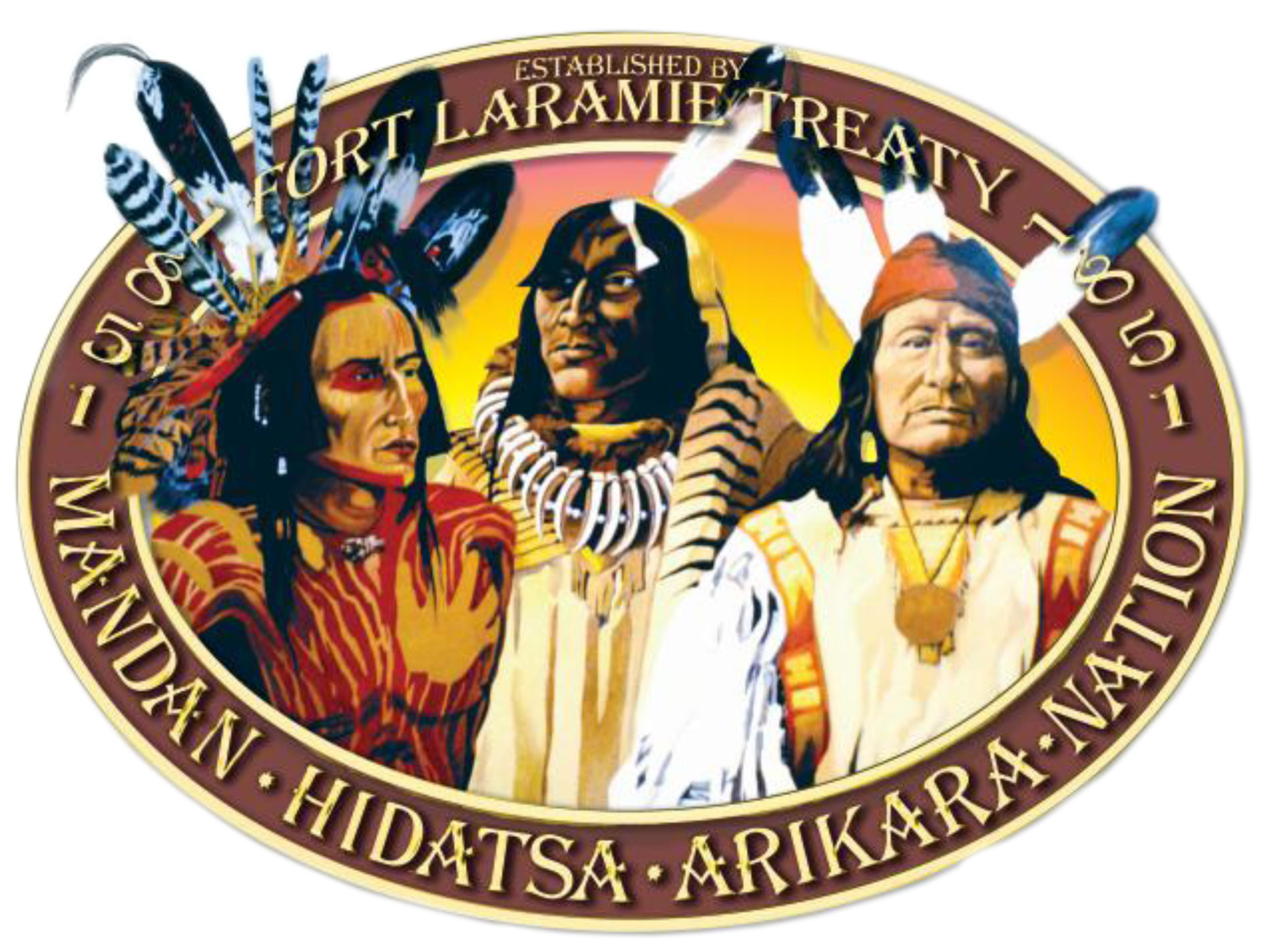
The great plague of smallpox struck the Three Tribes in June of 183 7, and this horrible epidemic brought disaster to these Indians. Francis A. Chardon's journals state that on July 14, a young Mandan died of smallpox and several more had caught it. The plague spread with terrible rapidity and raged with a violence unknown before. Death followed in a few hours after the victim was seized with pain in the head; a very few who caught the disease survived. The Hidatsa scattered out along the Little Missouri to escape the disease and the Arikara hovered around Fort Clark. But the Mandan remained in their villages and were afflicted worst; they were afraid of being attacked by Sioux if they ventured out of their villages. By September 30, Chardon estimated that seven-eighths of the Mandan and one-half of the Arikara and Hidatsa were dead. Many committed suicide because they felt they had no chance to survive. Nobody thought of burying the dead, death was too fast and everyone still living was in despair. The scene of desolation was appalling beyond the conception of the imagination. The Mandan were reduced from 1800 in June to 23 men, 40 women, and 60 to 70 young people by fall. Their Chief Four Bears, had died. (Shane, 1959, p. 199).
On July 28, 1837, Chardon wrote: "the second chief of the Mandan was the brave and remarkable Four Bears, life-long friend of the whites, recipient of the praises of Catlin and Maximilian, and beloved by all that knew him. "
Now, as his people were dying all about him, he spoke: My friends one and all, listen to what I have to say- Ever since I can remember, I have loved the whites. I have lived with them ever since I was a boy, and to the best of my knowledge, I have never wronged the white man, on the contrary, I have a/ways protected them from the insults of others, which they cannot deny. The Four Bears never saw a white man hungry, but what he gave him to eat, drink, and a Buffalo skin to sleep on in time of need. I was a/ways ready to die for them, which they cannot deny. I have done everything that a red skin could do for them, and how have they repaid it? With ingratitude! I have never called a white man a Dog, but today, I do pronounce them to be a set of black-hearted Dogs, they have deceived me, them that I always considered brother, has turned out to be my worst enemies. I have been in many battles, and often wounded, but the wounds of my enemies I exalt in, but today I am wounded, and by whom, by those same white Dogs that I have always considered, and treated as Brothers. I do not fear Death my friends. You know it, but to die with my face rotten, that even the Wolves will shrink with horror at meeting me, and say to themselves, that is the Four Bears, the friend of the Whites -listen well what I have to say, as it will be the last time you will hear me. Think of your wives, children, brothers, sisters, friends, and in fact all that you hold dear, are all dead, or dying, with their faces all rotten caused by those dogs the whites, think of all that my friends, and rise up all together and not leave one of them alive: The Four Bears will act his part. (Abel, p.124, 1932).
After the devastation of the smallpox epidemic of 1837, the Mandan, Hidatsa, and Sahnish combined forces for protection, economic and social survival. They still maintained separate ceremonies, clan systems, and bands and maintained their cultural identity.
Reprinted from https://www.mhanation.com/history
History for the Mandan, Hidatsa and Arikara
History for the Mandan, Hidatsa and Arikara
Reprinted from https://www.mhanation.com/history
Economic and social change
As a means to economic stability and the livelihood of tribes, Congress passed the Indian Gaming Regulatory Act (On October 17,1988). This legislation authorized Class III casino gaming on Indian Reservations.
Elbowoods
By 1888, Like-a-Fishhook Village was practically deserted as people were encouragedto establish communities on other parts of the reservation. Some of the people moved twenty miles up river where they established the new community of Elbowoods.
Reprinted from https://www.mhanation.com/history
Economic and social change
As a means to economic stability and the livelihood of tribes, Congress passed the Indian Gaming Regulatory Act (On October 17,1988). This legislation authorized Class III casino gaming on Indian Reservations. The act also afforded Indian tribes the opportunity to enter into management agreements with outside investors to develop gaming facilities. In the early 1990s, the Three Affiliated entered into a gaming compact with the state of North Dakota. The tribes undertook renovation of the existing Four Bears Motor Lodge, (a 1974, Office of Economic Opportunity Project), the conversion of the small gas station to a convenience store, and the construction of a recreational facility. The Four Bears Casino and Lodge was opened to the public July 16, 1993. Over 90 percent of the 322 employees were tribal members. The Four Bears Casino and Lodge currently offers lodging, restaurant, live entertainment, several forms of gaming, and a video arcade. A bingo hall was added to accommodate over 300 players.
Elbowoods
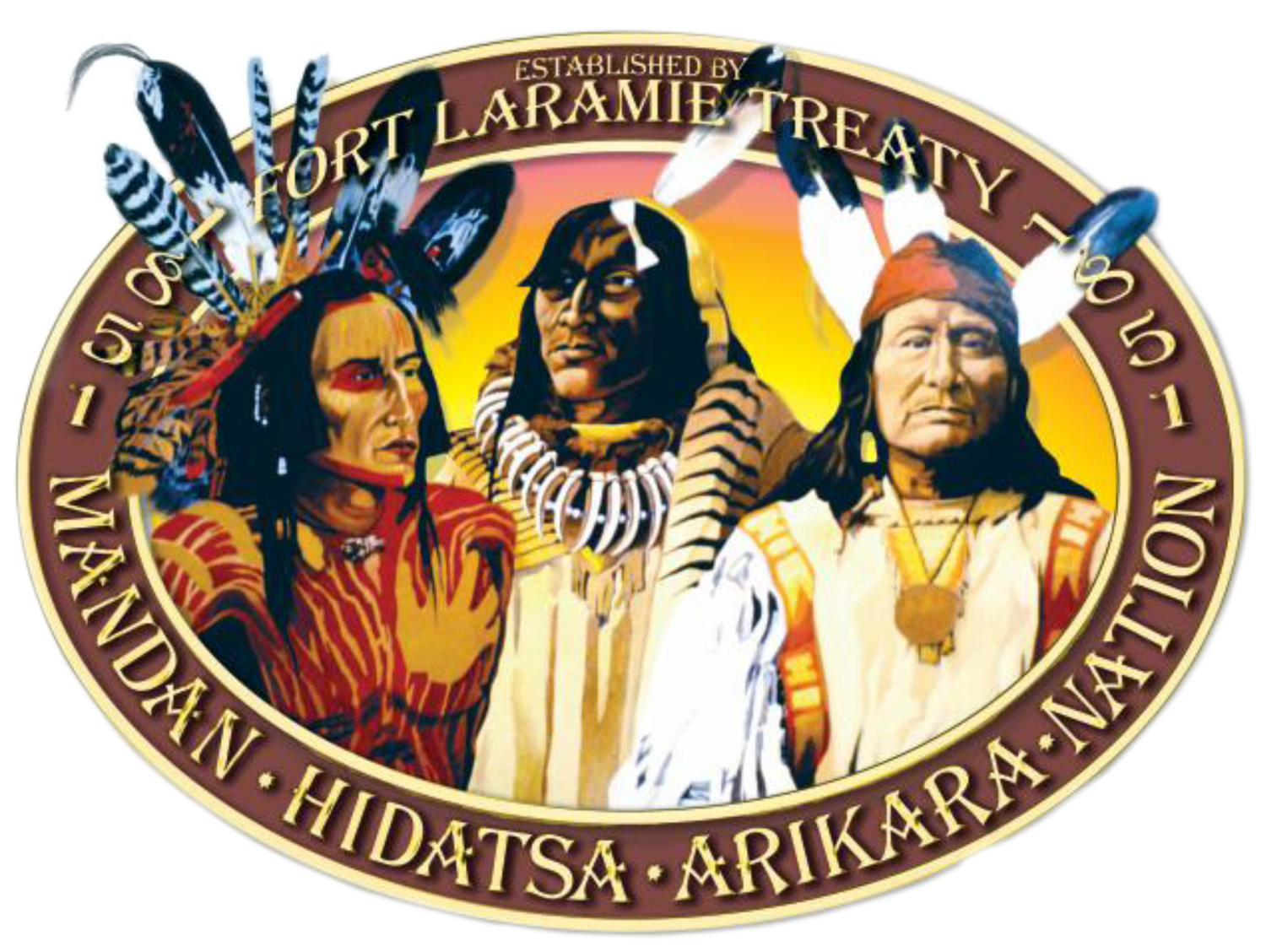
By 1888, Like-a-Fishhook Village was practically deserted as people were encouraged to establish communities on other parts of the reservation. Some of the people moved twenty miles up river where they established the new community of Elbowoods. A few elders refused to move and they remained at the Fishhook village. Again the government took land from the Mandan, Hidatsa, and Sahnish tribes. It was declared that the "Indians are desirous of disposing of a portion thereof in order to obtain the means necessary to enable them to become wholly self-supporting by the cultivation of the soil and other pursuits of husbandry.” (From Indian Affairs, Laws and Treaties).
The agency of Elbowoods was located on the east-side of the Missouri, so most people moved to the west-side of the river, away from the agent. Many people settled in small communities near the river, where they had previously wintered or hunted.
They situated themselves near a steep, sloped hill with a flat top, on the west bank of the Missouri, and on the east-side of the river. The Elbowoods agency later included a boarding school, hospital, agency headquarters, and a jail.
Reprinted from https://www.mhanation.com/history
History for the Mandan, Hidatsa and Arikara
History for the Mandan, Hidatsa and Arikara
Reprinted from https://www.mhanation.com/history
Early education and civilization
In the mid 1870s, assimilation in the form of education was now the focus of government policy. The agent declared that families who did not send their children to school would have rations (government annuities of food) withheld.
Early reservation life Indian agents
U.S. Government agents were assigned to various forts along the fur trading routes. These agents, who were former military officers, were entrusted to carry out federal policies put forth by treaties.
Reprinted from https://www.mhanation.com/history
Early education and civilization
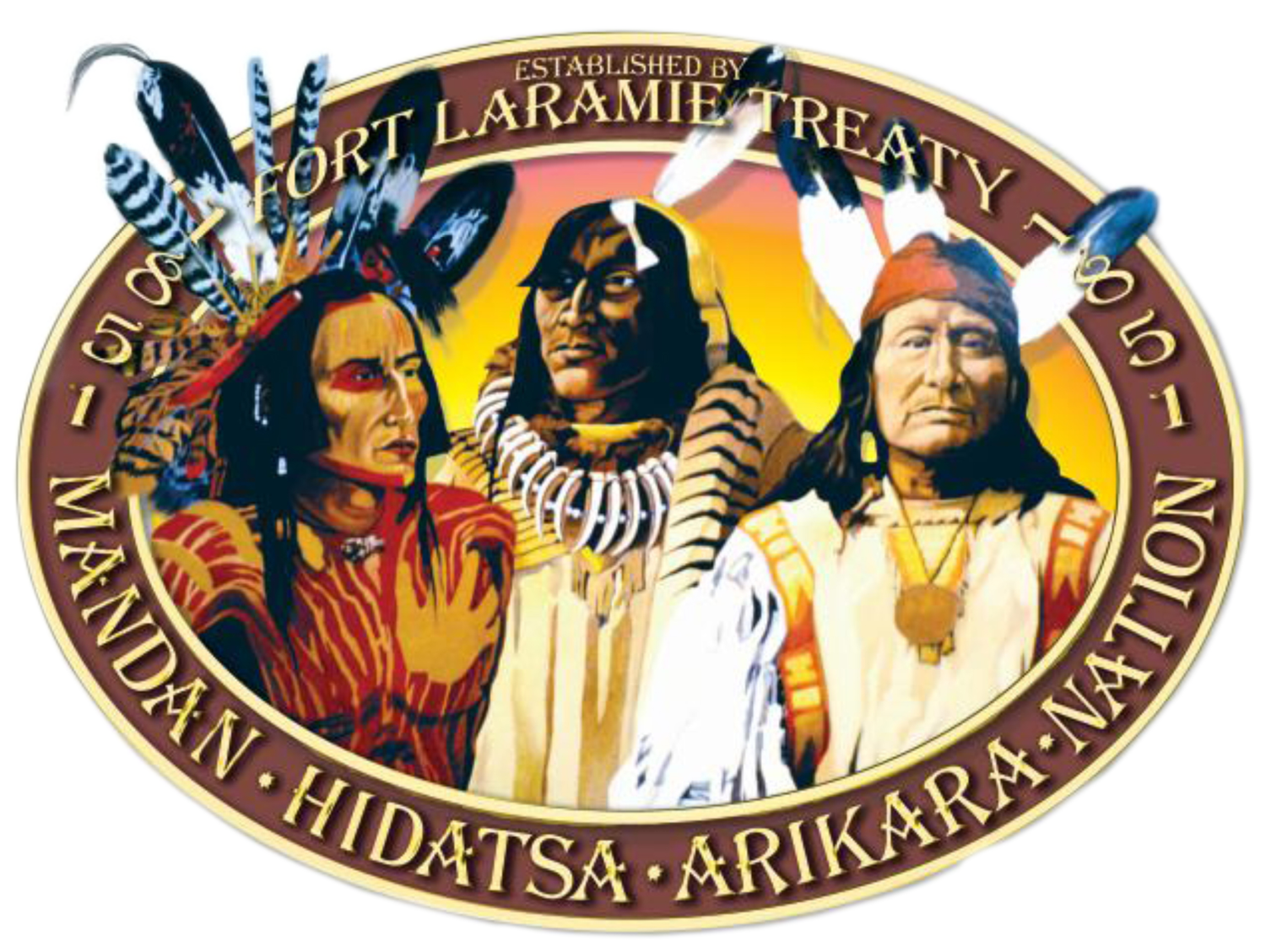
In the mid 1870s, assimilation in the form of education was now the focus of government policy. The agent declared that families who did not send their children to school would have rations (government annuities of food) withheld. Mandan, Hidatsa, and Sahnish children at Fort Berthold were attending school at Fort Stevenson boarding school or C. L. Halls' Congregational mission school. Many children were taken forcibly from their homes and sent off to schools such as Carlisle Indian School in Pennsylvania, and Hampton Institute in Virginia. According to oral historians, the children were forced to wear uniforms and carry wooden guns. They were given Christian names and in some cases, lost their original names completely.
Elders say many of the Indian people's ancestors became confused because the government agents were careless in keeping records and assigned names randomly. Many children ran away from the schools because the environment, food, clothing, language, and school personnel attitudes were unfamiliar to them. They were often caught and returned to the schools. They were not allowed to speak their own languages. If they did, they were severely punished. As a result of this, parents were afraid to allow their children to speak their own language. Very little English was spoken which hampered the children's ability to learn in school.
Early reservation life indian agents
U.S. Government agents were assigned to various forts along the fur trading routes. These agents, who were former military officers, were entrusted to carry out federal policies put forth by treaties. Distribution of annuities, yearly cash payments, and provisions promised to the three tribes, were sometimes never received. They became more restricted in their range and their ability to live from hunting and became more dependent on the United States for subsistence. The Mandan, Hidatsa and Sahnish and the Sioux had been unfriendly for centuries. The three tribes, numbering two thousand, were at a disadvantage to the forty thousand Sioux. During the period of the early 1860s, several bands of the Sioux, deprived of their home by the flood of whites into what is now Minnesota, pushed westward onto the plains of the Upper Missouri. When the Civil War started in 1861, military obligations in the Upper Missouri were neglected. Problems increased as whites passing through tribal lands to the gold fields caused restlessness among the Sioux.
The military became lax in their obligations to the military forts along these territories. Because the Mandan, Hidatsa and Arikara (Sahnish) remained friendly to the government and the whites, they were repeatedly attacked by Sioux. (Dunn, 1963, p. 201). Only after Fort Berthold and the surrounding villages were burned by raids did the government see fit to move the fort 17 miles further east. The new military post, known as Fort Stevenson, was built in 1867, on the north bank of the Missouri River at the mouth of Douglas Creek, near present-day Garrison.
At the same time as the Sioux signed several treaties to remain on friendly terms with the whites and other tribes, exploitation by Indian agents and fur traders continued cheating and depriving the Mandan, Hidatsa and Sahnish of their provisions from the government When the Arikara Chief, White Shield, refused to sign a receipt for goods he did not receive, Agent Mahlon Wilkinson was angry and declared White Shield removed as chief and declared him ineligible for his $200 annuity. Agent Wilkinson replaced White Shield with a younger man, Son-of-Star, as chief of the tribe. Agent Wilkinson said to White Shield, "My friend, you are getting too old. Age troubles your brain and you talk and act like an old fool. “The honorable Indian replied firmly, "I am old it is true. But not so old as not to see things as they are and even if, as you say, I were only an old fool, I would prefer a hundred times to be an honest red fool than a stealing white rascal like you." (de Trobriand, Army Life).
A severe smallpox epidemic ravaged the Mandan, Hidatsa and Sahnish in 1866. Their fall crops were a failure. After being robbed of their annuities, the authorities refused them any assistance. De Trobriand stated that the agents of the Indian Bureau were nothing but a vast association of thieves who made their fortune at the expense of the Indians and to the detriment of the government. Between 1866 and 1870, the Indian wars began to die out and the fur trade dwindled because of the scarcity of game. Immigration increased ten-fold and the railroads cross-cut the prairies, invading the homelands of the tribes. In 1870, a group of Hidatsa and some Mandan, who wanted to maintain their traditional way of life, left the village and moved 120 miles up river (outside the reservation boundary) and established themselves at Fort Buford, near what is now Williston, North Dakota. There were a number of reasons for the move, but one may have been a disagreement between Crow Flies High and government-supported leaders, Poor Wolf and Crows Paunch. One reason cited was over the distribution of rations.
Reprinted from https://www.mhanation.com/history
History for the Mandan, Hidatsa and Arikara
History for the Mandan, Hidatsa and Arikara
Early Conflicts war of 1823
A part of a national policy to show Indian nations the strength of the United States, the government requested that tribal people be brought to the east as representatives of their nations. In some cases, it was an effort on the part of the explorers and traders to show case their discoveries. The result of this policy can be seen with the incident at Leavenworth.
Reprinted from https://www.mhanation.com/history
Reprinted from https://www.mhanation.com/history
Early Conflicts war of 1823
A part of a national policy to show Indian nations the strength of the United States, the government requested that tribal people be brought to the east as representatives of their nations. In some cases, it was an effort on the part of the explorers and traders to show case their discoveries. The result of this policy can be seen with the incident at Leavenworth.
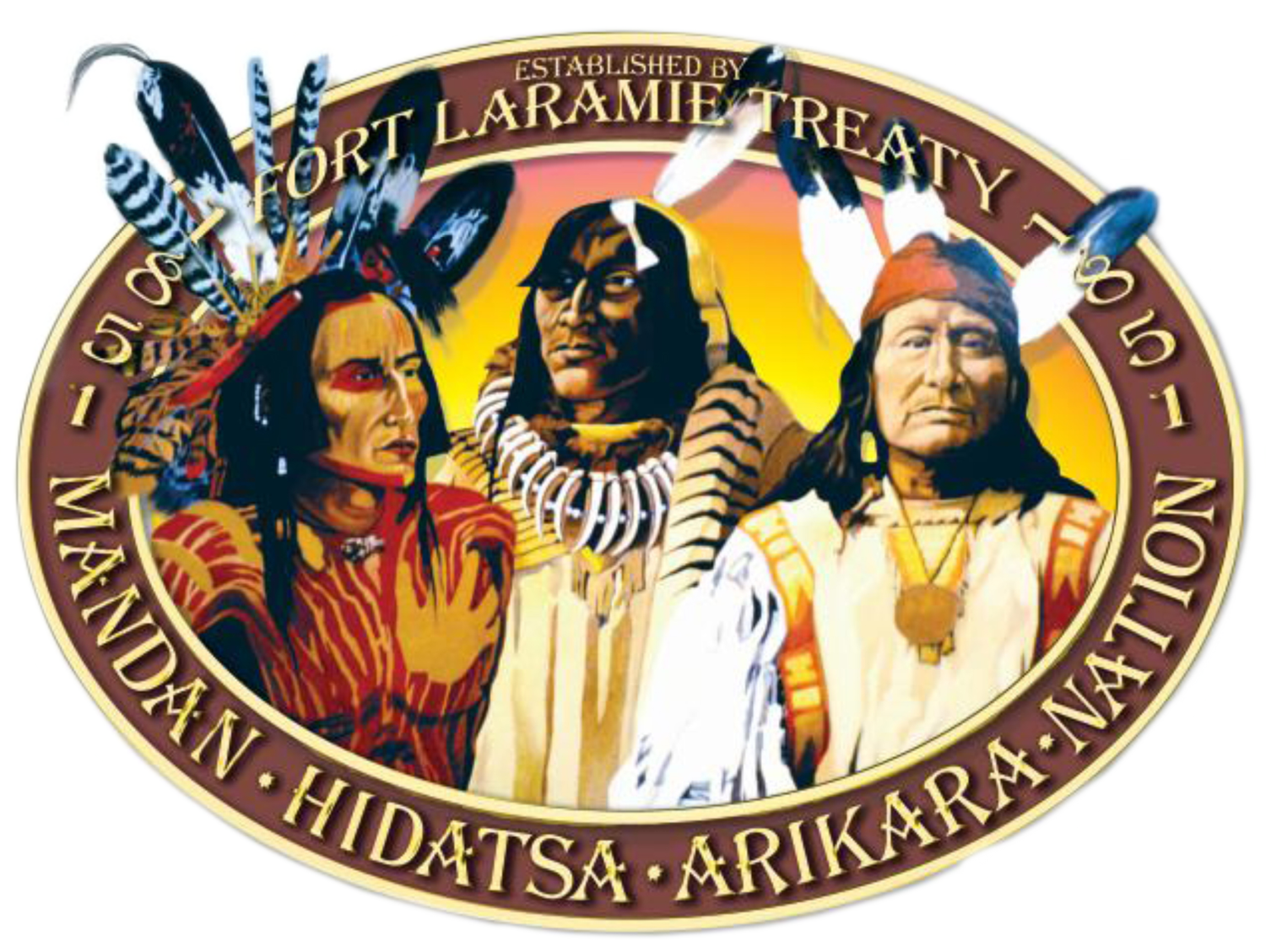
The incident began when explorers Lewis and Clark negotiated the trip that sent the Sahnish village chief, Ankedoucharo (Eagle Feather) to Washington, D.C. where he died. There was no explanation of how and why he died. Lewis and Clark, fearing the wrath of the Sahnish, did not tell them until a year later. When the Sahnish found out about his death, they became rightfully angry. President Thomas Jefferson tried to appease the Sahnish with the following eulogy: He (Chief Ankedoucharo) consented to go towards the sea as far as Baltimore and Philadelphia. He said the chief found nothing but kindness and good will wherever he went, but on his return to Washington he became ill. Everything we could do to help him was done but it pleased the Great Spirit to take him from among us. We buried him among our own deceased friends and relations. We shed many tears over his grave. (Delegates in Buckskins). The President's explanation did not impress the Sahnish.
For the next twenty years they were hostile to white people. The inexplicable death of their chief was the major reason for their so-called belligerence. The most notable of these hostilities was in the 1823 battle where the Sahnish took revenge for the death of their chief on General Ashley and his men who were coming up the river from St. Louis. The Sahnish killed several men, took some of their goods, and set their boats adrift in the river. The attack angered the white military forces and they set out with soldiers, artillery, cannons and 800 to 900 Sioux for Leavenworth to "teach the Arikara (Sahnish) a lesson." (Leavenworth Journal). The Sahnish had fortified their villages well. The Sioux were first into the battle, and when they met the Sahnish, they both lost lives. The Sioux, fearing Leavenworth was losing the battle met with the Sahnish. It was presumed they wanted to join the Sahnish. They then left the battle taking with them corn and other crops of the Sahnish leaving Leavenworth's forces to their own tactics. The Sahnish were surrounded by the United States military who lobbed cannonballs and other artillery into the village of men, women, and children. The Sahnish, realizing they were outnumbered and at risk, began negotiating for surrender. Before the battle could be settled, every man, woman, child, horse, and dog disappeared during the night.
According to a traditional story told among the people, a sacred dog led the people under the river and to safety. This time in history was a turning point in the relations between the Sahnish and whites. Prior to this battle, traders and travelers had described the disposition of the Sahnish towards the whites as "friendly." After this war, there were reports of hostilities and murders on both sides. The result of the Leaven worth battle infuriated the traders who further antagonized the Sahnish worsening the already deteriorating relationship between the Sahnish and the whites.
Reprinted from https://www.mhanation.com/history
History for the Mandan, Hidatsa and Arikara
History for the Mandan, Hidatsa and Arikara
CHANGE
During the late 1880s and early 1890s, a severe drought gripped the country. Bad weather and severe droughts destroyed crops of the Mandan, Hidatsa and Sahnish. Government attempts to “civilize” and “christianize” the Indians governed Federal policy, as was the blatant focus at breaking up their land base. In 1883, Secretary of the Interior Henry M. Teller initiated the Court of Indian Offenses. His goal was to eliminate "heathenish practices" among the Indians. (Secretary of Interior Report, Nov. 1,1883).
Reprinted from https://www.mhanation.com/history
Change
During the late 1880s and early 1890s, a severe drought gripped the country. Bad weather and severe droughts destroyed crops of the Mandan, Hidatsa and Sahnish. Government attempts to “civilize” and “christianize” the Indians governed Federal policy, as was the blatant focus at breaking up their land base. In 1883, Secretary of the Interior Henry M. Teller initiated the Court of Indian Offenses. His goal was to eliminate "heathenish practices" among the Indians. (Secretary of Interior Report, Nov. 1,1883).
J.D. Adkins, Commissioner of Indian Affairs from 1885 to 1888 exerted great influence and pressure to promote use of the English language in schools attended by Indian children stating "A wider and better knowledge of the English language among them is essential to their comprehension of the duties and obligations of citizenship." (Report of September 21, 1887, in House Executive Document, No.1, part 5, vol. II, 50th Congress, 1st Session, serial 2542, pp. 18-23).
School age children were sent to school and encouraged to become farmers. Indians were to follow the laws of the Court of Indian Offenses, which punished them for having more than one wife and for participating in dances and traditional religious ceremonies. Although many men agreed to become farmers or wage earners, difficulties were encountered in doing large-scale farming. Year after year, the crops were killed by droughts, early frost, insects, or other disasters. The Mandan, Hidatsa and Arikara were accustomed to farming only the floodplain of the Missouri for their crops, but the government wanted them to plant and raise surplus crops away from the river bottom.
In 1871, Indian agent Tappen reported that the men had broken 640 acres in the flood plain and grew enough corn and squash to last the winter. As a reward, the men were given wagons and horse harnesses. Later, they would grow wheat and oats, which was turned over to the agent to sell and the agent controlled the money made from the sale of these grains.
Agent Tappens' 1873 report, described the general surface of the land as not fertile, sparsely timbered, and without water. The Mandan, Hidatsa and Arikara were surrounded by wilderness of prairie for hundreds of miles where very little game lived, hardly a good location to start an agricultural economy. They worked diligently with the primitive implements given them and had nine hundred acres under cultivation. Corn, wheat, oats, barley, field peas, potatoes, turnips and garden varieties were raised. Agent Tappan requested proper accommodations for himself and his employees, a schoolhouse, with a dwelling for the teacher, two or more storehouses, a hospital building, where native doctors could be kept from patients, and a new building for a sawmill.
Indian agent, L.B. Sperry succeeded Tappan in 1874, and initiated a policy of giving annuities directly to the families instead of a chief. This policy eroded the role of the chief and the tribal system of the people. In 1874 the Commissioner of Indian Affairs, Edward P. Smith, urged the Mandan, Hidatsa and Arikara (Sahnish) to leave Fort Berthold, with its unproductive soil, unfriendly climate, scant supply of wood, poor water, high winds, dust, drought, frost, flood, grasshoppers, and the Sioux. That year a delegation from the Three Tribes went to the Indian Territory (Oklahoma) to investigate the possibilities of moving to that area. Although pleased with the country, they refused, fearing it would be too warm, dreading the long journey, and, most of all, losing their attachment to the place of their birth and homes of their dead. (Dunn, 1963). See letter in the Appendix.
Reprinted from https://www.mhanation.com/
History for the Mandan, Hidatsa and Arikara
ALLOTMENT
Congress passed the General Allotment Act of 1887, about the time the tribes moved out of Like-a-Fishhook Village. This Act was to put an end to the Indians' tribal rights to reservation land and make them individual land owners. It was also a well orchestrated and thought out scheme to separate the Indians from their lands. Any un-allotted Indian land could then be deemed government surplus, and dealt with however the government saw fit. It was given over for homesteads of settlers.
Reprinted from https://www.mhanation.com/history
Allotment
Congress passed the General Allotment Act of 1887, about the time the tribes moved out of Like-a-Fishhook Village. This Act was to put an end to the Indians' tribal rights to reservation land and make them individual land owners. It was also a well orchestrated and thought out scheme to separate the Indians from their lands. Any un-allotted Indian land could then be deemed government surplus, and dealt with however the government saw fit. It was given over for homesteads of settlers.
The Executive Order of 1891 provided for the allotment of the Fort Berthold Reservation. This order restricted the sale of un-allotted lands and reserved them for future members of the tribe. The reservation was to be divided into standardized plots-heads of families received 160 acres each, women and men over the age of 18 who were not heads of families were allotted 80 acres each, children received 40 acres each. The actual allotment of reservation land began in 1894. The General Allotment or Dawes Act of February 8, 1887, is an example of a change in the Governments ' policy towards Indian leadership that encouraged Government officials to deal with individuals or families, to bypass tribal leaders, and to ignore tribal governing structures. Had the Act been successful, the allotment policy would have brought an end to the reservation system. When people moved onto individual allotments, they were each given one of the following: a cook-stove, a yoke of work oxen, a breaking plow, a stirring plow, a cow, a wagon, an ax, a hoe, a spade, a hand rake, a scythe, and a pitch fork. They were expected to build a frame or log house on their allotment. All adult males were to work to support themselves, and children between eight and eighteen were to attend school. Farming on the bench lands did not go well those early years because of the lack of rain and poor soil.
The agency recommended cattle, sheep, and swine be added to supplement grain crops. This policy and practice contradicted Indian beliefs and practices. The Indians traditionally thought of land in terms of communal use and never as individually owned. Individual ownership made it easier for white people to purchase Indian lands. Millions of acres were lost as a result of this Act. The Dawes Act granted to individual Indians selected rights and privileges, but included constricting regulations, bringing then under control and watchful eye of the government. The goal of allotment was to replace tribal culture with the white man's culture. On December 14, 1886, the Mandan, Hidatsa and Sahnish signed away 1,600,000 acres of Fort Berthold land and the reservation was opened to white settlement. By 1891, through successive executive orders, epidemics, Indian agents, and allotments, the Mandan, Hidatsa and Arikara (Sahnish) were stripped of their property and disorganized as a group. Expected to assume a philosophy of individualism, they were, as individuals, pushed to lower and lower social and economic levels. (Dunn, 1963)
Reprinted from https://www.mhanation.com/
History for the Mandan, Hidatsa and Arikara
1900s
At the turn of the century, Indian lands were a primary focus of government interest. It was evident to the white man that the Indians had too much land. Continuous pressure was brought to bear on Congress and the Federal Government by many outside interests.
Reprinted from https://www.mhanation.com/history
1900s
At the turn of the century, Indian lands were a primary focus of government interest. It was evident to the white man that the Indians had too much land. Continuous pressure was brought to bear on Congress and the Federal Government by many outside interests. Through the successive allotment acts, and encroachment, Indian lands were being lost at a phenomenal rate. Jurisdiction over Indian lands continued to be the responsibility of the Bureau of Indian Affairs, but seemed likely to disappear as the Indians became independent landowners when they received patents and ownership of their own lands. It was the Indian Bureau's idea of ending the task of administering Indian lands by allowing their lands to be transferred to whites. In the 1901 Annual Report of the Indian Commissioner, Agent Richards stated that the annuities had expired and the agency would have to operate on the saving from the ten installments they had received since 1891. The agent thought they could sell a strip of land twelve miles wide on the north side of the reservation. A special agent later that year suggested selling off 200,000 acres on the west side.
Congress passed a law on March 3, 1901 to provide employment of a number of special agents to visit Indian reservations and negotiate for the sale of 'surplus' lands. James McLaughlin, veteran agent with many tribes, arrived at Fort Berthold in June, 1902. He proposed that the Mandan, Hidatsa and Sahnish sell about 315,000 acres of their land. They opposed. Upon reaching an agreement, the tribes agreed to sell 208,000 acres at $1.25 per acre, to build a fence, and to purchase bulls, mares, mowing machines, and rakes. The remaining funds were to be distributed equally to each individual. For unknown reasons, this proposal submitted to Congress was never ratified. A bill was introduced to effect the opening of the reservation land. The tribes objected because the government failed to hold a council with them and get their consent to the proposed legislation. The Act of June 1, 1910, provided for the outright cession of thirteen full and eight fractional townships and the rest of the reservation north and east of the Missouri except for allotments made to individuals. Certain lands were also reserved for agency, school, and mission purposes on the left bank of the river, and provision was also made for the protection of the site of Like-a-Fishhook Village. Allotments of 160 acres of agricultural land or 320 acres of grazing land were to be made to every member of the Tribes, over and above all previous allotments. Individuals were to receive a sum equal to the appraised value, not a flat sum as proposed. Although this represented a victory for the Indians, not all were satisfied. The reservation was becoming a narrow strip on both sides of the Missouri. More land went out of Indian ownership.
Reprinted from https://www.mhanation.com/

The Lame Warrior and the Skeleton
Photo from Native American Story Teller: The Story of the Magic Windpipe. Painting from https://www.warpaths2peacepipes.com
In the days before horses, a party of young Arapahos set off on foot one autumn morning in search of wild game in the western mountains. They carried heavy packs of food and spare moccasins, and one day as they were crossing the rocky bed of a shallow stream a young warrior felt a sudden sharp pain in his ankle. The ankle swelled and the pain grew worse until they pitched camp that night.
Story from https://www.indigenouspeople.net/lamewarr.htm

Photo from Native American Story Teller: The Story of the Magic Windpipe. Painting from https://www.warpaths2peacepipes.com
In the days before horses, a party of young Arapahos set off on foot one autumn morning in search of wild game in the western mountains. They carried heavy packs of food and spare moccasins, and one day as they were crossing the rocky bed of a shallow stream a young warrior felt a sudden sharp pain in his ankle. The ankle swelled and the pain grew worse until they pitched camp that night.
Next morning the warrior's ankle was swollen so badly that it was impossible for him to continue the journey with the others. His companions decided it was best to leave him. They cut young willows and tall grass to make a thatched shelter for him, and after the shelter was finished they collected a pile of dry wood so that he could keep a fire burning.
"When your ankle gets well," they told him, "don't try to follow us. Go back to our village, and await our return."
After several lonely days, the lame warrior tested his ankle, but it was still too painful to walk upon. And then one night a heavy snowstorm fell, virtually imprisoning him in the shelter. Because he had been unable to kill any wild game, his food supply was almost gone.
Late one afternoon he looked out and saw a large herd of buffalo rooting in the snow for grass quite close to his shelter. Reaching for his bow and arrow, he shot the fattest one and killed it. He then crawled out of the shelter to the buffalo, skinned it, and brought in the meat. After preparing a bed of coals, he placed a section of ribs in the fire for roasting.
Night had fallen by the time the ribs were cooked, and just as the lame warrior was reaching for a piece to eat, he heard footsteps crunching on the frozen snow. The steps came nearer and nearer to the closed flap of the shelter. "Who can that be?" he said to himself. "I am here alone and unable to run, but I shall defend myself if need be." He reached for his bow and arrow.
A moment later the flap opened and a skeleton clothed in a tanned robe stood there looking down at the lame warrior.
The robe was pinned tight at the neck so that only the skull was visible above and skeleton feet below. Frightened by this ghost, the warrior turned his eyes away from it.
"You must not be frightened of me," the skeleton said in a hoarse voice. "I have taken pity on you. Now you must take pity on me. Give me a piece of those roast ribs to eat, for I am very hungry."
Still very much alarmed by the presence of this unexpected visitor, the warrior offered a large piece of meat to an extended bony hand. He was astonished to see the skeleton chew the food with its bared teeth and swallow it.
"It was I who gave you the pain in your ankle," said the skeleton. "It was I who caused your ankle to swell so that you could not continue on the hunt. If you had gone on with your companions you would have been killed. The day they left you here, an enemy war party made a charge upon them, and they were all killed. I am the one who saved your life."
Again the skeleton's bony hand reached out, this time to rub the warrior's ankle. The pain and swelling vanished at once. "Now you can walk again," the ghost said. "Your enemies are all around, but if you will follow me I can lead you safely back to your village."
At dawn they left the shelter and started off across the snow, the skeleton leading the way. They walked through deep woods, along icy streams, and over high hills. Late in the afternoon the skeleton led the warrior up a steep ridge. When the warrior reached the summit, the ghost had vanished, but down in the valley below he could see the smokes of tepees in his Arapaho village.
Copyright @ 1993-2015
This page on www.indigenouspeople.net/lamewarr.htm was last updated 10/18/2015 10:10:43

The Sacredness of Water
September 6, 2025
This video is part of a set of interviews for the WoLakota Project. www.wolakotaproject.org “WoLakota” implies balance and coming together. The WoLakota project supports students in high-need schools, pairing trained mentor-teachers with new teachers and providing Courage to Teach circles to tend to the ʻheartsʼ of each. Mentors support the embedding of the Oceti Sakowin Essential Understandings (OSEU) into practice, complementing the Common Core. The OSEU address the achievement gap of American Indian students by embracing their identity, and promote cultural understanding among non-native students and teachers. Lakota Elder Dottie LeBeau states, “When we approach teaching with one worldview…we create systems of failure in our schools.” WoLakota closes the circle into a system of understanding and success. The WoLakota Project is a partnership between TIE and the SD Department of Education
This video is part of a set of interviews for the WoLakota Project. www.wolakotaproject.org “WoLakota” implies balance and coming together. The WoLakota project supports students in high-need schools, pairing trained mentor-teachers with new teachers and providing Courage to Teach circles to tend to the ʻheartsʼ of each. Mentors support the embedding of the Oceti Sakowin Essential Understandings (OSEU) into practice, complementing the Common Core. The OSEU address the achievement gap of American Indian students by embracing their identity, and promote cultural understanding among non-native students and teachers. Lakota Elder Dottie LeBeau states, “When we approach teaching with one worldview…we create systems of failure in our schools.” WoLakota closes the circle into a system of understanding and success. The WoLakota Project is a partnership between TIE and the SD Department of Education
Mr. Hollow Horn Bear is a member of our advisory counsel, one of the original Elder-authors of the Oceti Sakowin Essential Understandings. Duane is also a wonderful storyteller. We are so happy to be able to share some of the stories he has shared in both English and Lakota language formats.

The Story of Time
August 2, 2025
This video is part of a set of interviews for the WoLakota Project. www.wolakotaproject.org “WoLakota” implies balance and coming together. The WoLakota project supports students in high-need schools, pairing trained mentor-teachers with new teachers and providing Courage to Teach circles to tend to the ʻheartsʼ of each. Mentors support the embedding of the Oceti Sakowin Essential Understandings (OSEU) into practice, complementing the Common Core. The OSEU address the achievement gap of American Indian students by embracing their identity, and promote cultural understanding among non-native students and teachers. Lakota Elder Dottie LeBeau states, “When we approach teaching with one worldview…we create systems of failure in our schools.” WoLakota closes the circle into a system of understanding and success. The WoLakota Project is a partnership between TIE and the SD Department of Education
This video is part of a set of interviews for the WoLakota Project. www.wolakotaproject.org “WoLakota” implies balance and coming together. The WoLakota project supports students in high-need schools, pairing trained mentor-teachers with new teachers and providing Courage to Teach circles to tend to the ʻheartsʼ of each. Mentors support the embedding of the Oceti Sakowin Essential Understandings (OSEU) into practice, complementing the Common Core. The OSEU address the achievement gap of American Indian students by embracing their identity, and promote cultural understanding among non-native students and teachers. Lakota Elder Dottie LeBeau states, “When we approach teaching with one worldview…we create systems of failure in our schools.” WoLakota closes the circle into a system of understanding and success. The WoLakota Project is a partnership between TIE and the SD Department of Education
Mr. Hollow Horn Bear is a member of our advisory counsel, one of the original Elder-authors of the Oceti Sakowin Essential Understandings. Duane is also a wonderful storyteller. We are so happy to be able to share some of the stories he has shared in both English and Lakota language formats.

Native American Indian Legends and Folklore
From https://www.legendsofamerica.com/na-crazywomansfork/
July 5, 2025
In the journey through that most delightful region of Montana from Fort Phil Kearney, Wyoming to Fort C. F. Smith (in the Powder River country), one of the most favored camping grounds is the one called “Crazy Woman’s Fork,” the name of a pretty little stream of water that rises in the Big Horn Mountains, and empties into the Little Horn River. About three miles from the mountains, this stream crosses the trail between the two military posts.
From https://www.legendsofamerica.com/na-crazywomansfork/
Legend of Crazy Woman’s Fork
By Edmund B. Tuttle in 1873

Tipis on the Little Bighorn River
The Absaraka, or Crow Nation, has the reputation of being good friends to the whites, and it is also said they have never warred with them.
Iron Bull, a renowned chief of the Crow, relates the following legend:
In the journey through that most delightful region of Montana from Fort Phil Kearney, Wyoming to Fort C. F. Smith (in the Powder River country), one of the most favored camping grounds is the one called “Crazy Woman’s Fork,” the name of a pretty little stream of water that rises in the Big Horn Mountains, and empties into the Little Horn River. About three miles from the mountains, this stream crosses the trail between the two military posts.
This camp on the Fork is noted for its danger from Indian attacks, as an abundant supply of game being found in the valley brings the Indian there to replenish his larder of wild meat.

Two Whistles, a Crow Medicine Man
Notwithstanding the dangers attending a journey through this region, it has its attractions in the beautiful and diversified views of lovely scenery, which hasten the parties traveling that region to encamp, for a night at least, on the banks of a limpid stream that refreshes man and beast from an unfailing source in the mountains. The banks are skirted with cottonwood trees, and to the west, one sees the tall spurs of the Rocky Mountains rising, as it were, from your feet, their dizzy heights covered with snow. Yet, at the same time, the haze that surrounds them gives them a halo of glory and weird-like appearance that the imaginative might compare to the garments that mantle the spirits of the blessed in Paradise!
Iron Bull said that about two hundred years ago, when the moon shone brighter, and there were more stars, his nation was a great people, and they roamed over all that country from the Missouri River to the west of the Yellowstone River, and no dog of a Sioux dare show himself there. But the people had been wicked, and the Great Spirit had darkened the heavens and made the sun to shine with such heat that the streams were dried up, and the snow disappeared from the highest peaks of the mountains. The buffalo, the elk, the mountain sheep, the deer, and the rabbit all disappeared and died away, bringing a great famine upon his tribe. The spirit of the air breathed death into the lodges so that the warrior saw his wife and papooses die for want of the food he could not find on all the plain or the mountainsides; so that the whole nation grieved and mourned in sorrow of heart.
Still, they kept up their wars with the Sioux and fought many a bloody battle with them when they suffered most, and the game had entirely disappeared. Their great medicine man called a council, and when the head-men had assembled, he told them of a wonderful dream that he had had, when the Great Spirit bid him to gather the chiefs of the tribe at the fork of the stream where they lived.

Upper Missouri River Breaks by Bob Wick, Bureau of Land Management
Their ponies had all been eaten for food, so the proud Indians were compelled to make the journey on foot to the place of meeting.
But when they had arrived at the bluffs, on the edge of the valley, they were surprised to see a bountiful supper spread on the bank of the stream, close by the Forks, and a white woman close by, standing up and making signs to them to descend from the bluffs.
Having never before seen a “white woman,” they were greatly astonished. So the medicine man descended to the valley. The white woman told him that the Great Spirit would talk to the council through her. She told him that the wars of the tribe were displeasing to the Great Spirit, and they must make peace with the Sioux nation. When that was done, the great chief, “The-Bear-that-grabs,” must return to her.
They sent out runners to the Sioux, and peace was declared between the tribes for the first time in 100 years.

Apsaroke/Crow Bull Chief at the Ford by Edward S. Curtis, 1905
She then told the great chief to follow the mountain in a westerly course until he came to the Big Horn River, and where the rock was perpendicular, he was to shoot three arrows, hitting the rock each time.
The chief departed on his mission, and as he gained the bluffs from the stream, he looked back at the white woman, but what was his surprise when he saw her rising in the air and floating towards the mountains! He watched her until she disappeared over the highest peak towards the sky.
The chief pursued his journey, and, arriving at the place told him by the white woman, he discharged his arrows. The first one struck in rock. The second flew over the mountain. The third was discharged, and a terrible noise followed: the heavens were aglow with lightning; the thunder shook the mountains.
The earth trembled, and the rocks were rent asunder, and out of the fissure, countless herds of buffalo came, filling the valleys and the hills. The hearts of the Indians were glad, and they ate and were merry and returned thanks to the Great Spirit and the good white woman.
The great fissure in the rocks is the canyon of the Big Horn River.
Iron Bull avers that when anything of note is about to befall the tribe, the image of the white woman can be seen hovering over the peak of the mountain at “Crazy Woman’s Fork.” He says the Crow have never killed any of the whites, and his people say and believe “that they are treated by the government agents worse than the tribes who give us all the trouble.”
In other words, because they are peaceable, we need not, as with others, buy them off with presents. And they say we have taken some of their lands and given them to the Sioux, who were fighting and destroying the whites as often as possible.
By Edmund B. Tuttle, 1873. Compiled and edited by Kathy Weiser/Legends of America, updated June 2021.
Also See:
The Crow – Skilled Horseman of Montana
Legends, Ghosts, Myths & Mysteries
Native Americans – First Owners of America
Native American Legends & Tales
Author and Notes: The Legend Of Crazy Woman’s Fork was written by Edmund B. Tuttle in 1873. It was included in his book, Three Years on the Plains: Observations of Indians, 1867-1870. Tuttle was the post chaplain at Fort D. A. Russell in Wyoming Territory. As such, he was an eyewitness to the evolving relationship between the U.S. military and the American Indians, particularly the Sioux and the Cheyenne. In 1873, Tuttle wrote about the events he had observed, both historic and commonplace, during his time at the fort.

Native American Indian Legends and Folklore
Image from Unsplash.com
June 7, 2025
In Plains Indian stories, Coyote nearly always takes the shape of a man. He is clever but reckless, and is constantly getting himself and the people around him into trouble with his socially inappropriate behavior like greed, boastfulness, lying, and chasing women. Coyote stories are usually humorous in nature, and many of them contain what today is considered 'adult humor.' Other Plains Coyote legends are cautionary tales about the consequences of bad behavior and the dangers of interacting with irresponsible people. Although Coyote usually either narrowly avoids death or returns to life after being killed, the mortals around him are not always so lucky.
From https://www.native-languages.org/legends-coyote.htm
The coyote is one of several North American animals whose name has Native American origins. The word "coyote" was originally a Spanish corruption of the Nahuatl (Aztec) word for the animal, coyotl. From there it was borrowed into English.
Coyote is a major mythological figure for most Native American tribes, especially those west of the Mississippi. Like real coyotes, mythological coyotes are usually notable for their crafty intelligence, stealth, and voracious appetite. However, American Indian coyote characters vary widely from tribe to tribe. In some Native American coyote myths, Coyote is a revered culture hero who creates, teaches, and helps humans; in others, he is a sort of antihero who demonstrates the dangers of negative behaviors like greed, recklessness, and arrogance; in still others, he is a comic trickster character, whose lack of wisdom gets him into trouble while his cleverness gets him back out. In some Native coyote stories, he is even some sort of combination of all three at once.
Among the Pueblo tribes, the coyote was believed to have hunting medicine. Zuni hunters kept stone effigies of coyotes as one of their six hunting fetishes, associating coyotes with the west and the color blue. Coyotes are also used as clan animals in some Native American cultures. Tribes with Coyote Clans include the Cahuilla tribe, the Mohave, the Hopi (whose Coyote Clan is called Isngyam or Ish-wungwa), the Zuni (whose Coyote Clan name is Suski-kwe,) and other Pueblo tribes of New Mexico. Some tribes, such as the Pomo, also had a Coyote Dance among their tribal dance traditions.
Native American Coyote Gods and Spirits
Native American Legends: Chirich
Name: Coyote (Plains Indian)
Tribal affiliation: Sioux, Arikara, Cheyenne, Blackfoot, Caddo
Also known as: Old Man Coyote
Native names: Mica, Maca, Chirich
Type: Animal spirits, trickster, coyote
Related figures in other tribes: Coyote (West Coast), Coyote (Southwest), Jamul (Achumawi)
Coyote is one of the two major trickster figures of Plains Indian mythology. (The other is Iktomi or Spider, and the same stories are often told with Coyote as the main character in one community and Iktomi/Spider as the main character in another.)
In Plains Indian stories, Coyote nearly always takes the shape of a man. He is clever but reckless, and is constantly getting himself and the people around him into trouble with his socially inappropriate behavior like greed, boastfulness, lying, and chasing women. Coyote stories are usually humorous in nature, and many of them contain what today is considered 'adult humor.' Other Plains Coyote legends are cautionary tales about the consequences of bad behavior and the dangers of interacting with irresponsible people. Although Coyote usually either narrowly avoids death or returns to life after being killed, the mortals around him are not always so lucky.
How He Got Tongue

Wihio was living in his home, and not far away was a camp of people. One day he had nothing to eat, and now way to kill anything; so he paid a visit to one of his neighbors, hoping that he would be asked to eat with them.
When Wihio stepped into the lodge he saw that there was plenty of food there--dried meat and back fat and tongues. Every time the man went out he killed an elk, and when he did so he took the tongue out and saved it, and tongues hung all about his lodge. Wihio longed for the tongues but the man did not offer him any; he just gave him some dried meat. As Wihio was returning to his lodge, he saw a coyote not far off, and called to him asking him to come in.
When the coyote had sad down, Wihio told him about what he had seen in the man's lodge, and he asked the coyote to go there with him again, so they might eat there.
The coyote thought the man would not let him come in, because everyone knows that coyotes always steal meat.
"Well," said Wihio, "let us arrange some plan by which you can come. What can we do? How can we get in?" The coyote thought for a long time, and at last he told Wihio how they might do what they wished to. The coytoe said, "You dress up like a woman, and tie me up like a baby, and carry me there. Give me good things to eat when you get the meat."
"Ah," said Wihio, "it is good, I will give you a part of everything that is given to me." Then he began to tie up the coyote like a baby, so that he could carry him. After he had done so, he took up the coyote on his arm like a baby, and went back to the lodge and said to the man, "My child is crying for food." Wihio whispered to the coyote to cry for tongue, and he did so. The man asked Wihio what the baby wanted, and Wihio said, "He is crying for tongue." The man took a tongue and put it in the water and boiled it.
After the tongue was cooked the man gave it to Wihio, who began to eat, and gave the coyote only just a taste of it. Wihio ate all he could, for he was hungry. The coyote kept whispering to him, "Give me some too, I am hungry"; but Wihio continued to eat, and just dipped his fingers in the soup and let the coyote lick them. At last the coyote grew angry and said, "I am going to tell him about you, that you have dressed me up like a baby in order to get some tongue."
Wihio kept eating very fast, and gave the coyote none of the tongue, and at last went out of the lodge, carrying the baby. He went to the river, and said to the coyote, "You were going to tell about me, were you? You ought to keep quiet when I'm eating; you trouble me too much." Then he threw the coyote, all tied up, into the river, and he floated down the stream.
From www.angelfire.com/ca/Indian/HowHeGotTongue.html

Native American Indian Legends and Folklore
May 3, 2025
From www.warpaths2peacepipes.com
The coyote deity Chirich is the trickster figure of Arikara mythology. He is clever but reckless, and is forever getting himself and the people around him into trouble, particularly through socially inappropriate behavior like greediness, boastfulness, lying, and chasing women. Like modern cartoon characters, Chirich frequently dies during the course of his adventures and returns randomly to life-- it is impossible to truly get rid of that trickster for good. Chirich stories are often humorous in nature, but they can also be cautionary tales about the consequences of bad behavior and the dangers of interacting with irresponsible people.
From https://www.native-languages.org/legends-coyote.htm
The coyote is one of several North American animals whose name has Native American origins. The word "coyote" was originally a Spanish corruption of the Nahuatl (Aztec) word for the animal, coyotl. From there it was borrowed into English.
Coyote is a major mythological figure for most Native American tribes, especially those west of the Mississippi. Like real coyotes, mythological coyotes are usually notable for their crafty intelligence, stealth, and voracious appetite. However, American Indian coyote characters vary widely from tribe to tribe. In some Native American coyote myths, Coyote is a revered culture hero who creates, teaches, and helps humans; in others, he is a sort of antihero who demonstrates the dangers of negative behaviors like greed, recklessness, and arrogance; in still others, he is a comic trickster character, whose lack of wisdom gets him into trouble while his cleverness gets him back out. In some Native coyote stories, he is even some sort of combination of all three at once.
Among the Pueblo tribes, the coyote was believed to have hunting medicine. Zuni hunters kept stone effigies of coyotes as one of their six hunting fetishes, associating coyotes with the west and the color blue. Coyotes are also used as clan animals in some Native American cultures. Tribes with Coyote Clans include the Cahuilla tribe, the Mohave, the Hopi (whose Coyote Clan is called Isngyam or Ish-wungwa), the Zuni (whose Coyote Clan name is Suski-kwe,) and other Pueblo tribes of New Mexico. Some tribes, such as the Pomo, also had a Coyote Dance among their tribal dance traditions.
Native American Coyote Gods and Spirits
Native American Legends: Chirich
Name: Chirich
Tribal affiliation: Arikara
Alternate spellings: Scirihts
Pronunciation:schee-reetch
Also known as: Coyote
Type: Animal spirit, trickster, coyote
Related figures in other tribes: Coyote (Plains)
The coyote deity Chirich is the trickster figure of Arikara mythology. He is clever but reckless, and is forever getting himself and the people around him into trouble, particularly through socially inappropriate behavior like greediness, boastfulness, lying, and chasing women. Like modern cartoon characters, Chirich frequently dies during the course of his adventures and returns randomly to life-- it is impossible to truly get rid of that trickster for good. Chirich stories are often humorous in nature, but they can also be cautionary tales about the consequences of bad behavior and the dangers of interacting with irresponsible people.
Magic Windpipe
The Native American Arikara Story of the Magic Windpipe
The Red Indian Fairy Book by Frances Jenkins Olcott
An Arikara Story

Native American Story Teller: The Story of the Magic Windpipe. Painting from https://www.warpaths2peacepipes.com
The Arikara Story of the Magic Windpipe A long time ago there lived a beautiful Indian girl. Her lodge was on the edge of a forest, and she dwelt alone. And though she never hunted or fished, she always had plenty to eat, and no one knew where it came from. In her lodge hung a magic bundle, and near it were seven tiny bows and a lot of grass arrows.
One day as she was eating her dinner, Coyote came through the forest, and stopped at her door. He saw that she had roast Buffalo meat, and he licked his chops.
"You have no man around," said he to the girl; "may I stay and do your errands?"
"Yes," said she, "you may stay."
So Coyote lived with her, and made her fires and brought water from the spring.
By and by all the Buffalo meat was gone, and Coyote wondered how she was going to get more. Then the girl said:—"Uncle Coyote, our food is gone. I want some fresh meat. My brothers will be here to-day. Do you go to the north side of the entrance and cover your head with a Buffalo robe, and don't watch what I do."
So Coyote did as he was told, and when his head was covered, he peeped out and saw the girl sweep the lodge clean. Then she placed hot coals in the centre of the room, and put some sweet-grass on the coals. As the smoke arose, she lifted the magic bundle from the wall, and opening it, took out the windpipe of a Buffalo. It was round, and small at one end, and big at the other.
She waved the windpipe over the smoke, and turned the small end down, and some dust fell out on the floor. Then the dust changed into seven handsome braves, her brothers.
The young men took down the tiny bows and arrows from the wall, and they changed into big bows and arrows.
The girl wrapped herself in a Buffalo robe, then went and stood in the door. She gave a yell to the north, and a yell to the west, and immediately herds of Buffalo came rushing over the plain. Then she went back into the lodge, and her brothers began to kill the Buffalo. When they had killed as many as they wanted, the rest of the animals ran away, and the brothers came back into the lodge.
The girl put more sweet-grass on the coals, and when the smoke rose up the brothers stepped behind it, and disappeared. The girl took the magic windpipe, held it over the coals, gathered up a handful of dust from the floor, and put it into the windpipe. After that she put the windpipe into the magic bundle and hung it again on the wall.
She next passed the big bows and arrows through the smoke and they became tiny bows and grass arrows, and she hung them up, too.
Now, Coyote was very much astonished to see all this, but he kept quiet. By and by the girl called him, and showed him the dead Buffalo. He helped her to skin the animals, and to dry the flesh. After that she let Coyote roast all the bones he wished.
When Coyote had eaten the roast meat, he began to think of his hungry children at home, and said to himself, "If I only had that magic windpipe, I could call the Buffalo whenever I wished, and the seven young braves would kill them for me."
Then he asked the girl if the windpipe held more than seven young men. "Oh, yes," said she; "whenever I turn the big end upside down, a war party comes out, headed by my seven brothers, and they fight for me."
When Coyote heard this, he decided to steal the windpipe that night, for he thought, "When my enemies see all those braves, they will think me powerful, and will run away."
Now the girl knew that Coyote was planning to steal the windpipe, and she let him take it. That night, when she was asleep, he lifted down the magic bundle from the wall, and, opening it, took out the windpipe and ran away fast toward the north.
He travelled far until he was tired, and then lay down by a log to sleep. The girl knew this, and she told her brothers to bring him back. They did so, and placed him on the floor of the lodge.
And when he woke in the morning, there he lay, with the magic windpipe in his paw, and the girl looking at him.
"Oh, my niece," said he, "I thought a war-party was coming in the night, so I took this down. Put it back." So the girl tied the windpipe up in the magic bundle, and hung it on the wall.
The next night Coyote ran away again with the magic windpipe, and when he came to a place where he thought he was safe, he lay down to sleep. The girl told her brothers to bring him back. They did so, and placed him on the floor of the lodge.
And when he woke in the morning, there he lay, with the magic windpipe in his paw, and the girl looking at him.
"Oh, my niece," said he, "I took this down because the enemy came in the night, and I frightened him away. Put it back." So the girl tied the windpipe up again, and hung it on the wall. And the same thing happened the third night.
The fourth time Coyote stole the magic windpipe, the girl let him take it and did not tell her brothers to bring him back. No, indeed! She let him go on until he came to a village. He was very hungry, so he said to himself, "I will call out the people and order them to feed me, and if they do not obey, I will turn the big end of the windpipe upside down, and the war-party will come out."
So he called out the people, and the braves came running and shouting from the lodges, and the boys and dogs came too. And when they saw Coyote, the men and boys began to kick him, and throw stones at him, and the dogs bit him. He turned the windpipe upside down, when, instead of a war-party, out burst a whole swarm of Bumblebees, millions of them, buzzing with rage.
They settled all over Coyote, and stung him so hard that he ran howling into the forest. And they kept on stinging him until he was well punished for his lying and stealing.
After that, the Bumblebees swarmed up into a hollow tree, and they have lived there ever since. As for the magic windpipe, the brothers took it back to the girl.

Painting from https://www.warpaths2peacepipes.com
The Story of the Magic Windpipe This story of the Magic Windpipe is featured in the book entitled the Red Indian Fairy Book by Frances Jenkins Olcott published in Boston, New York by Houghton Mifflin Company in 1917.

The Mandan, Hidatsa and Arikara
April 5, 2025
The Hidatsa are made up of three closely related bands: the Hidatsa Proper, the Awatixa, and the Awaxawi. The Hidatsa Proper call themselves Hiraacá—traditionally thought to mean “willow.” Having originally lived in the Devil’s Lake region in what is now eastern North Dakota, by the early 1600s, the Hidatsa had moved to settle along the Missouri River in west-central North Dakota—near the Mandan.
February 28, 2019 by Hunter Old Elk
from the Buffalo Bill Center of the West
The Hidatsa
The Hidatsa are made up of three closely related bands: the Hidatsa Proper, the Awatixa, and the Awaxawi. The Hidatsa Proper call themselves Hiraacá—traditionally thought to mean “willow.” Having originally lived in the Devil’s Lake region in what is now eastern North Dakota, by the early 1600s, the Hidatsa had moved to settle along the Missouri River in west-central North Dakota—near the Mandan. The two tribes were usually on good terms, both speaking Siouan dialects, although the languages were not mutually intelligible. The Hidatsa lived near the junction of the Knife and Missouri Rivers, about sixty miles up from the Mandan.

Hide shirt, ca. 1890. Hiraaca (Hidatsa). NA.202.1308
The Hidatsa lived in substantial earth-covered lodges clustered in villages of several hundred to more than a thousand individuals. These stable communities were perched on the rims of terraces overlooking the Missouri River floodplains. In the lowlands, the Hidatsa grew bountiful gardens of corn, beans, squash, and sunflowers all owned and tended to by the women, while the men hunted white-tailed deer and other woodland animals. Behind the villages were the river bluffs that separated the valley from the rolling, upland plains, where they hunted pronghorn and the massive herds of buffalo. The products produced denoted the Hidatsa villages as major part of the ancient Indigenous trading center of the Plains—and later when the Euro-Americans arrived.
Hidatsa society is matrilineal—meaning descent is traced from the mother’s side of the family. Hidatsa says that a person comes into the world through their mother’s clan, and leaves through their father’s clan. Meaning that the mother’s clan bestows membership and belonging; while the father’s clan gives them distinct rights and responsibilities. The clan structure arranged an individual’s participation in life events and ceremonies.
After a smallpox epidemic in 1781, the Mandan moved upriver to live near the Hidatsa, as their numbers had been so reduced, they were no longer able to defend their villages. Farther downriver, near the mouth of the Grand River, lived the Arikara, the third group of Earth lodge dwelling Natives. Although they spoke a different language (being related to the Pawnee of Nebraska), their villages and way of life were much the same as those of the Hidatsa and Mandan. The Hidatsa also maintained relationships with their relatives to the west, the Crow.
The American artist George Catlin visited the tribes in 1832 and remained with them for several months in 1832. In 1833 – 1834, the Swiss artist Karl Bodmer, traveling with German explorer Prince Maximilian zu Wied-Neuwied, drew and painted the clothing and people and cultures of the villages.
Both Catlin and Bodmer’s artworks recorded the Hidatsa and Mandan societies, that where were rapidly changing under pressure from encroaching settlers, infectious disease, and government restraints. After an 1834 attack by the Dakota and the 1837 smallpox epidemic that reduced the Hidatsa to about 500 people, the three groups merged with the Mandan at Like-a-Fishhook Village in 1845. The Arikaras joined them in 1856. Further reading: A Living Tradition: Plains Indian Food and Medicine.

The Boy and the Bear
March 1, 2025
This video is part of a set of interviews for the WoLakota Project. www.wolakotaproject.org “WoLakota” implies balance and coming together. The WoLakota project supports students in high-need schools, pairing trained mentor-teachers with new teachers and providing Courage to Teach circles to tend to the ʻheartsʼ of each.
This video is part of a set of interviews for the WoLakota Project. www.wolakotaproject.org “WoLakota” implies balance and coming together. The WoLakota project supports students in high-need schools, pairing trained mentor-teachers with new teachers and providing Courage to Teach circles to tend to the ʻheartsʼ of each. Mentors support the embedding of the Oceti Sakowin Essential Understandings (OSEU) into practice, complementing the Common Core. The OSEU address the achievement gap of American Indian students by embracing their identity, and promote cultural understanding among non-native students and teachers. Lakota Elder Dottie LeBeau states, “When we approach teaching with one worldview…we create systems of failure in our schools.” WoLakota closes the circle into a system of understanding and success. The WoLakota Project is a partnership between TIE and the SD Department of Education
Mr. Hollow Horn Bear is a member of our advisory counsel, one of the original Elder-authors of the Oceti Sakowin Essential Understandings. Duane is also a wonderful storyteller. We are so happy to be able to share some of the stories he has shared in both English and Lakota language formats.